Heat Pump Repair in Saint George, UT
Prompt on-site heat pump diagnostics and repairs engineered for year-round cooling and heating demands across Washington County.
Direct Field Dispatch
Connect directly with regional HVAC field technicians. Rapid emergency troubleshooting available.
(435) 348-8603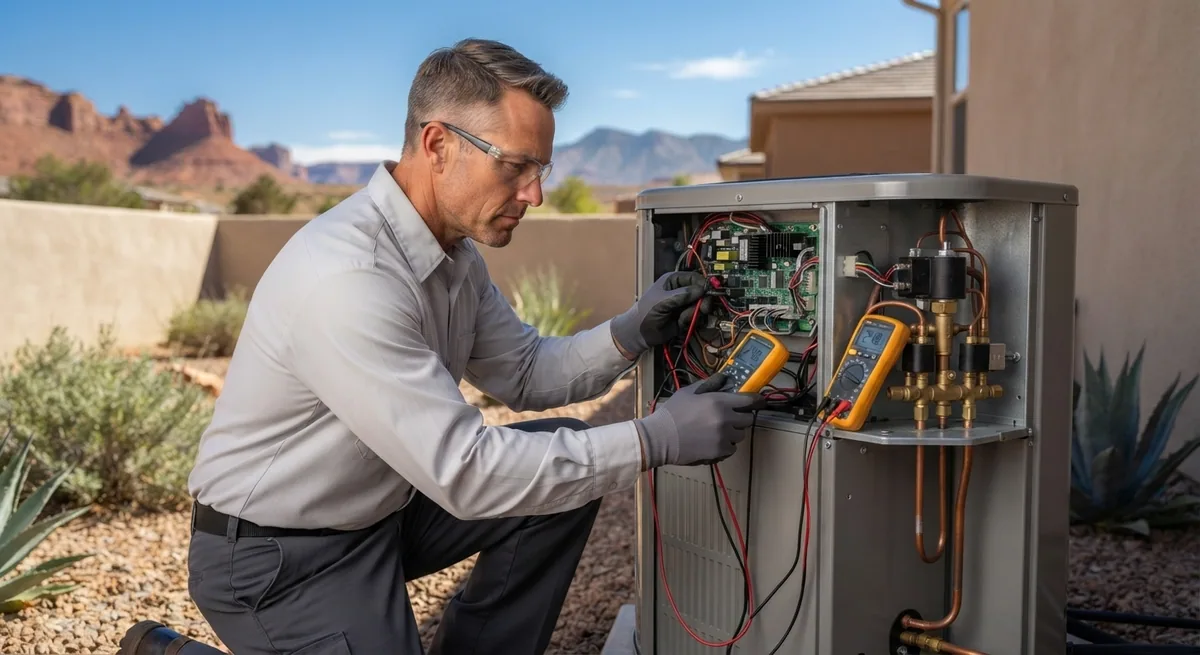
Quick Key Takeaways – Heat Pump Repair
Precision Heat Pump Repair in Saint George, Utah
Heat pump systems represent the fastest-growing and most thermally efficient climate control technology utilized across Saint George and Washington County. Because Southern Utah experiences both scorching summer heat waves exceeding 110 degrees Fahrenheit and freezing winter desert nights dropping into the 20s Fahrenheit, an air-source heat pump operates in both directions, acting as an air conditioner in the summer and reversing its thermodynamic cycle to provide clean, energy-efficient heat during the winter. However, because heat pumps operate virtually all twelve months of the year, their mechanical components absorb double the operational wear of standard cooling-only units.
As part of our comprehensive residential and commercial HVAC services, our local dispatch network coordinates prompt, disciplined heat pump repairs across Saint George, Washington, Santa Clara, Ivins, and Hurricane. Every service call is handled by background-vetted, professional HVAC technicians who specialize in advanced heat pump engineering, including four-way reversing valves, solid-state defrost control boards, electronic expansion valves (EEV), auxiliary electric resistance heat strips, and variable-speed inverter compressors.
Whether your heat pump is blowing cold air during a winter freeze, blowing warm air during a summer heat wave, encasing its outdoor coil in solid ice, or cycling rapidly on high-pressure safety switches, our network delivers empirical diagnostics, itemized written estimates, and clean-tech property protection. To understand system pricing benchmarks, consult our heat pump cost guide, or review cooling-specific diagnostics on our air conditioning repair page.
The Complexity of Heat Pump Engineering in Southern Utah
Unlike a traditional central air conditioner paired with a gas furnace, a heat pump utilizes a single refrigeration circuit to deliver both heating and cooling. Understanding how these reversible systems fail under Southern Utah's extreme desert temperature swings helps property owners identify mechanical problems early:
1. Four-Way Reversing Valve Solenoid and Mechanical Slide Failures
The four-way reversing valve is the mechanical heart of a heat pump. It directs the flow of high-pressure refrigerant vapor from the compressor either to the indoor coil (for heating) or to the outdoor coil (for cooling). The valve relies on an electromagnetic solenoid coil that shifts a delicate internal Teflon slide via internal pilot gas pressures:
- Electrical Solenoid Failure: If the 24V solenoid coil burns out or loses control voltage, the reversing valve defaults to its de-energized position (cooling mode on most brands). As a result, when you call for winter heat, the system blows freezing air into your home.
- Mechanical Slide Binding: In Saint George's high-ambient summer heat, overheated compressor oil can break down, forming carbon varnish inside the valve. This causes the internal sliding shuttle to stick midway, allowing high-pressure hot gas to bypass directly back into the compressor suction port, crippling both heating and cooling capacity.
2. Defrost Control Board, Sensors, and Coil Freeze-Ups
During winter operation, the outdoor coil absorbs heat from cold outdoor air, operating at temperatures well below freezing. When outdoor ambient temperatures drop into the 30s with winter desert humidity, frost accumulates across the outdoor aluminum coil fins. The system must enter an automated defrost cycle every 30 to 90 minutes:
- How Defrost Works: The defrost control board temporarily energizes the reversing valve to switch the unit back into cooling mode (melting the outdoor frost with hot gas) while simultaneously energizing indoor electric heat strips to prevent blowing cold air into your home.
- Failure Mode: If the outdoor defrost thermostat, ambient air temperature thermistor, or control logic board fails, the unit will never enter defrost. The outdoor coil becomes encased in a solid block of ice, crushing aluminum fins, starving the fan motor of airflow, and forcing the compressor into high-amperage failure.
3. Auxiliary Electric Heat Strip Staging and Sequencer Burnout
Because heat pumps lose heating capacity when outdoor temperatures plunge into the 20s Fahrenheit, residential systems feature auxiliary electric resistance heat strips (typically 5 kW to 15 kW) inside the indoor air handler cabinet to provide supplementary heat. These high-voltage heating coils are managed by thermal time-delay sequencers or electronic staging relays. In Southern Utah, power surges from summer desert lightning storms or loose electrical connections can burn out sequencers or trip thermal fusible links, leaving your home without backup heat when sub-freezing cold snaps arrive.
4. Electronic Expansion Valve (EEV) and Inverter Compressor Faults
Modern high-efficiency heat pumps installed across Washington County feature variable-speed inverter compressors and micro-stepper Electronic Expansion Valves (EEV). Rather than operating at fixed speeds, inverter electronics convert incoming AC power to DC and modulate motor frequency continuously. In extreme desert heat, the outdoor inverter circuit board (inverter drive) can overheat or suffer component failure from thermal expansion, generating complex diagnostic error codes that require specialized electronic multimeters to troubleshoot.
Common Heat Pump Symptoms: When to Call for Field Dispatch
Recognizing heat pump warning signs early prevents minor electrical control faults from escalating into catastrophic compressor burnout:
- Heat Pump Blowing Cool Air in Winter Heating Mode: If your heat pump is blowing 70-degree room air instead of warm 90 to 100-degree supply air, the reversing valve may be stuck in cooling mode, the refrigerant charge may be low, or the auxiliary heat strips have failed to stage properly.
- Outdoor Unit Encased in a Solid Block of Ice: A light dusting of white frost that melts away every hour is normal operation. However, if the outdoor unit is encased in a thick, solid block of ice from top to bottom, the defrost control circuit has failed, and the unit must be serviced immediately.
- "Aux Heat" or "Em Heat" Light Running Constantly on Thermostat: If your thermostat displays "Auxiliary Heat" or "Emergency Heat" continuously, your high-efficiency outdoor heat pump has stopped running, forcing your home to rely 100 percent on expensive electric resistance heat strips, which can cause monthly Dixie Power electric bills to double or triple.
- Loud "Whooshing" Sound Accompanied by Steam: A loud whoosh followed by steam rising from the outdoor unit is actually normal—it is the reversing valve shifting into its defrost cycle. However, if the whoosh is accompanied by metallic clattering, severe vibration, or the fan motor grinding against ice, the defrost cycle is malfunctioning.
- Rapid Short-Cycling (Turning On and Off Every 2 to 3 Minutes): Short-cycling in heat pumps is frequently caused by a malfunctioning high-pressure cutoff switch, severely restricted airflow across dirty indoor filters, or failing electronic thermistor sensors.
5-Step Empirical Heat Pump Diagnostic and Repair Workflow
Technicians dispatched through our Saint George network follow a structured, scientific diagnostic protocol to isolate complex refrigeration, electrical, and inverter faults:
REVERSING VALVE TESTING → DEFROST CYCLE SIMULATION → REFRIGERANT SUBCOOLING → AUXILIARY HEAT STRIPS → WRITTEN ESTIMATE
Step 1: Control Voltage and Reversing Valve Verification
The technician checks 24V control signals at the thermostat and outdoor defrost board, testing whether the reversing valve solenoid coil is properly energized. Using infrared temperature probes, the technician measures the temperature drop across all four copper ports of the reversing valve to verify that the internal mechanical slide is shifting fully without internal hot gas bypass.
Step 2: Forced Defrost Cycle Simulation
The technician places a jumper across the test pins on the outdoor defrost control board to force the system into a simulated defrost cycle. This verifies that the reversing valve shifts instantly, the outdoor fan motor shuts off as designed, and the indoor auxiliary heat strips energize to temper the indoor air supply.
Step 3: Dual-Mode Refrigerant Evaluation
Using calibrated digital manifold gauges and pipe thermistors, the technician measures high-side and low-side pressures in both heating and cooling modes. The technician calculates real-time subcooling in cooling mode and superheat in heating mode, verifying that the electronic expansion valve (EEV) or dual thermostatic expansion valves are metering refrigerant precisely.
Step 4: Auxiliary Electric Heat Strip and Amp Draw Testing
The technician inspects the indoor air handler's electric heat package. Using an electrical clamp meter, the technician measures running amperage on each individual 5 kW heating element, tests thermal limit switches, and verifies that thermal sequencers stage heating banks smoothly without tripping main panel circuit breakers.
Step 5: Itemized Written Estimate and Precision Repair
The technician explains the exact root cause of failure and presents an itemized written estimate detailing all necessary parts and labor before initiating any repairs. Following your written approval, the technician installs OEM components, tests the heat pump through full heating, cooling, and defrost cycles, and verifies proper indoor temperature splits.
Heat Pump Diagnostic Comparison Matrix
The table below outlines common heat pump repair scenarios encountered across Saint George and Washington County:
| Failure Symptom | Failing Component | Root Mechanical Cause | Empirical Diagnostic Tool | Professional Repair Procedure |
|---|---|---|---|---|
| Blowing Cold Air in Heating Mode | 4-Way Reversing Valve Solenoid | Solenoid coil burned out from voltage spike | Multimeter Ohmmeter / 24V Test | Replace 24V solenoid coil; verify control signal from thermostat |
| Outdoor Unit Encased in Heavy Ice | Defrost Control Board / Thermistor | Failed bi-metal defrost switch or timer board | Forced Defrost Test Pins / Continuity | Replace electronic defrost board and pipe-mounted defrost thermistor |
| Auxiliary Heat Not Working on Freezing Nights | Thermal Limit / Heat Strip Sequencer | Electrical fatigue from repeated thermal cycling | Amp Clamp Meter on Heating Element | Replace defective thermal sequencer and high-temp fusible link |
| System Trips Breaker Immediately on Start | Inverter Compressor Drive Board | Thermal burnout from extreme 115°F desert heat | True-RMS DC Voltage and Ohms Test | Replace outdoor inverter module; test compressor winding resistance |
| Hissing Sound at Reversing Valve, Poor Capacity | Internal Mechanical Slide Stuck | Carbon varnish from overheated compressor oil | Infrared Thermal Temp Differential | Replace contaminated 4-way reversing valve; flush refrigeration loop |
| Short-Cycling in Cooling Mode | High-Pressure Cutoff Switch | Restricted outdoor coil fins from red sand dust | Digital Gauge Manifold Reading | Perform deep chemical wash of condenser fins; reset safety switch |
Why Professional Heat Pump Maintenance Is Essential
Because a heat pump in Saint George works continuously across all four seasons—handling extreme summer cooling and winter desert heating—it accumulates twice the operating hours of a standard cooling-only system. Semi-annual preventative maintenance is critical:
- Spring Cooling Tune-Up: Chemically washing outdoor condenser coils to remove embedded red sand dust, testing electrical run capacitors, and calibrating cooling subcooling. Explore our AC maintenance service page.
- Fall Heating Tune-Up: Simulating defrost cycles, verifying reversing valve operation, testing auxiliary electric heat strips, and checking indoor static pressure. Review our heat pump maintenance overview.
- Protecting Inverter Electronics: Ensuring outdoor control boards are free of ant intrusion, dust accumulation, and loose wire terminals prevents expensive electronic drive board failures.
Serving All Washington County Communities
Our heat pump repair teams provide prompt, dedicated service across all local municipalities:
- Saint George, UT (84770, 84790): Bloomington, Little Valley, SunRiver, The Ledges, and Stone Cliff. Review our Saint George location page.
- Washington, UT (84780): Washington Fields, Coral Canyon, and Green Springs. Visit our Washington UT dispatch page.
- Santa Clara, UT (84765): Historic Santa Clara and elevated hillside subdivisions. Explore our Santa Clara UT page.
- Ivins, UT (84738): Snow Canyon corridor and Kayenta. Read our Ivins UT overview.
- Hurricane, UT (84737): Central Hurricane and Sky Mountain. Visit our Hurricane UT page.
Frequently Asked Questions About Heat Pump Repair
Is it normal for my heat pump to steam in the winter?
Yes. During the winter, your heat pump's outdoor coil naturally accumulates frost. When the system enters its automated defrost cycle, it temporarily switches into cooling mode to direct hot refrigerant gas through the outdoor coil, melting the frost. The melted ice turns into steam, which can rise from the outdoor unit for 2 to 5 minutes, often accompanied by a loud whooshing sound. This is completely normal operation. However, if your unit is encased in thick ice and never steams, the defrost cycle is broken and requires repair.
Why is my heat pump blowing air that feels cooler than a gas furnace?
A natural gas furnace delivers supply air at 120 to 140 degrees Fahrenheit, while a high-efficiency heat pump typically delivers air at 90 to 100 degrees Fahrenheit. Because human body temperature is approximately 98.6 degrees, air blowing at 92 degrees can feel slightly cool to the touch even though it is effectively warming your 68-degree room. If the supply air temperature drops below 85 degrees in heating mode, your system has an active mechanical issue requiring diagnosis.
Can an aging heat pump be repaired, or should I replace it?
If your heat pump is under 10 years old and has suffered an electrical component failure (such as a capacitor, contactor, defrost board, or reversing valve solenoid), repairing the unit is typically very cost-effective. However, if your heat pump is over 12 to 14 years old, has suffered a grounded compressor burnout, or uses obsolete R-22 refrigerant, investing in a modern high-SEER2 inverter heat pump provides substantial electrical savings and 10-year warranty coverage. Explore replacement options on our heat pump installation page.
Schedule Professional Heat Pump Repair in Saint George Today
Do not allow a malfunctioning heat pump to leave your home without cooling in the summer or heat in the winter. Connect directly with our Saint George field dispatch desk to schedule an empirical on-site diagnostic assessment with an experienced, background-vetted technician.
Call our local dispatch desk today at (435) 348-8603, or submit your project details online through our contact page.
Dispatch Field Hotline
Connect directly with our local response coordinator to route a technician to your property.
(435) 348-8603Related Trade Services
Pricing Transparency
Review current regional parts and labor benchmarks across our comprehensive local pricing directory.
Explore HVAC Cost Guides →Our 4-Step HVAC Service Methodology
Engineered to guarantee rapid local response, empirical diagnostic accuracy, upfront pricing clarity, and code compliance.
Discovery and Dispatch
Direct telephone intake with our Saint George dispatch desk to record symptoms, assess thermal urgency, and route the nearest field unit directly to your property.
Empirical Diagnostic
Comprehensive physical, thermal, and electrical diagnostic testing of your cooling or heating system to pinpoint the root mechanical failure without guesswork.
Clear Project Estimate
We clearly explain our diagnostic findings and provide a transparent, itemized written estimate detailing scope and materials for your approval before starting work.
Precision Execution
Flawless repair or installation utilizing OEM parts, adherence to Utah mechanical codes, full thermodynamic testing, and thorough clean-up upon completion.
Speak Directly With Our Field Dispatch Desk
Connect immediately with our local Saint George response desk for prompt technician dispatch, empirical diagnostics, and clear project estimates.