Air Conditioning Replacement in Saint George, UT
Seamless cooling system modernizations engineered to eliminate recurring breakdowns and lower summer utility bills across Washington County.
Direct Field Dispatch
Connect directly with regional HVAC field technicians. Rapid emergency troubleshooting available.
(435) 348-8603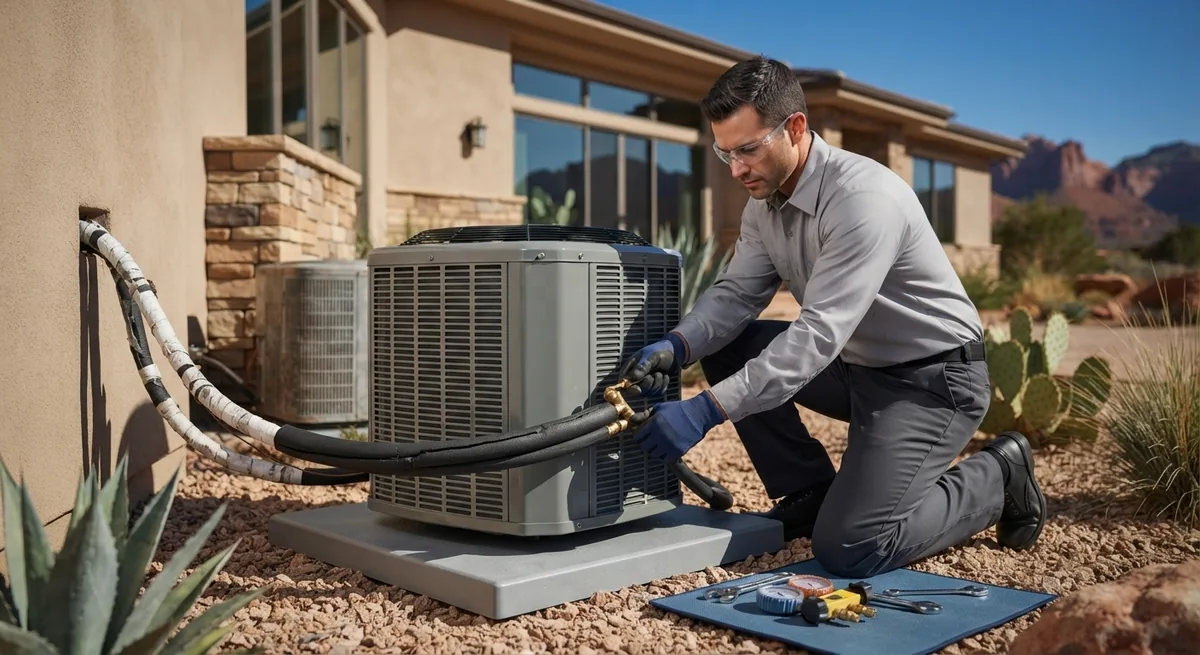
Quick Key Takeaways – AC Replacement
Strategic Air Conditioning Replacement in Saint George, Utah
Deciding when to replace an aging residential or commercial air conditioning system is one of the most significant maintenance and investment milestones for any property owner in Saint George, Utah. In Washington County's extreme Mojave Desert climate, cooling equipment operates under prolonged high-ambient thermal stress that significantly accelerates physical and mechanical wear. While an air conditioner in a mild Midwestern climate might operate reliably for 18 to 20 years, an air conditioning system in Saint George that has logged 12 to 15 years of service has endured thousands of hours of intense heat displacement, high head pressures, and abrasive red sand dust exposure.
As part of our comprehensive residential and commercial HVAC services, our field dispatch network coordinates seamless, high-efficiency cooling system replacements throughout Saint George, Washington, Santa Clara, Ivins, and Hurricane. We connect homeowners with background-vetted, professional HVAC technicians who evaluate equipment condition objectively, calculate precise heat loads, and execute turnkey equipment transitions that deliver immediate energy savings, superior indoor comfort, and decade-long warranty peace of mind.
If you are currently evaluating whether to repair an older unit or invest in a new platform, review our air conditioning repair service page for diagnostic comparisons, or consult our comprehensive AC replacement cost guide to review regional parts, labor, and equipment pricing benchmarks.
The Economics of Replacement: When Repair No Longer Makes Sense
Homeowners frequently struggle with the decision of whether to invest another $800 to $1,500 into an aging system or replace it entirely. In the HVAC industry, professional technicians rely on objective engineering criteria to help property owners make financially sound decisions:
1. The Rule of 5,000
A proven financial rule of thumb utilized by mechanical engineers and energy consultants is the "Rule of 5,000." Multiply the age of your air conditioning unit (in years) by the total cost of the proposed repair estimate:
- If the result is less than $5,000, repairing the unit is typically a reasonable short-term decision.
- If the result is greater than $5,000, system replacement is almost always the more cost-effective long-term path.
Example: If your air conditioning system is 13 years old and requires a $900 fan motor and capacitor replacement ($13 \times 900 = 11,700$), the system has far exceeded the threshold where ongoing repairs make financial sense. Sinking significant capital into a unit nearing catastrophic compressor failure leaves you vulnerable to another major breakdown during a 110-degree heat wave.
2. The Phased-Out R-22 Freon Dilemma
If your cooling equipment was installed prior to 2010, it almost certainly operates on R-22 refrigerant (commonly known by the brand name Freon). Under the Montreal Protocol and U.S. Clean Air Act regulations, virgin production and importation of R-22 were completely banned on January 1, 2020.
Today, only scarce, reclaimed, or recycled R-22 exists, driving refrigerant prices to astronomical levels. If an older R-22 system develops an evaporator coil leak or copper hairpin fracture, simply recharging the refrigerant charge can cost upwards of $1,000 to $2,000 without fixing the underlying metal corrosion. Investing that money into a modern, energy-compliant R-410A or next-generation R-32 system is far more financially prudent.
3. Chronic Summer Reliability Anxiety
An air conditioner should provide effortless peace of mind. If your system requires annual service visits just to make it through the summer, trips circuit breakers during late afternoon heat, or leaves your bedrooms uncomfortably warm while running non-stop, the equipment has reached mechanical exhaustion. Modern replacements eliminate breakdown anxiety and provide a full 10-year manufacturer parts warranty.
Thermodynamic and Energy Efficiency Upgrades (SEER to SEER2)
The technological leap between an aging 10 or 12 SEER air conditioner installed in 2008 and a modern 16 to 20+ SEER2 cooling platform installed today is staggering. Understanding these efficiency gains demonstrates how a replacement pays for itself over time:
OLD 10-12 SEER SYSTEM (Single-Stage, High Energy Consumption, Frequent Breakdowns)
         ↓ UPGRADE and MODERNIZATION ↓
MODERN 16-20+ SEER2 PLATFORM (Variable-Speed Inverter, 35-50% Electric Bill Reduction, 10-Year Warranty)
- Energy Consumption Reductions: Under the updated Department of Energy SEER2 testing standards for the Southwest region, a modern 16 to 18 SEER2 two-stage or inverter system consumes between 35 and 50 percent less electricity than a legacy 10 SEER unit to produce the exact same cooling capacity.
- Lower Dixie Power Electric Bills: In Saint George, where residential electric bills from Dixie Power or Saint George Energy Services routinely exceed $300 to $500 monthly during summer peak cooling months, an energy reduction of 40 percent translates into $120 to $200 in monthly operational savings. Over the system's 12 to 15-year desert lifespan, energy savings alone can offset a substantial portion of initial replacement costs.
- Precision Variable-Speed Humidity and Temperature Modulation: Older units operate like light switches—slamming on at 100 percent capacity and shutting completely off. Modern variable-speed inverter compressors modulate their output in tiny 1 percent increments between 25% and 100%, maintaining a perfectly constant indoor temperature (within 0.5 degrees Fahrenheit) while eliminating the jarring electrical surges that strain home wiring.
Comprehensive AC Replacement Evaluation Matrix
The decision matrix below outlines how professional technicians evaluate an existing cooling system to determine repair viability versus immediate replacement recommendation:
| Evaluation Dimension | Repair Recommended | Strategic Replacement Recommended | Critical Saint George Desert Factor |
|---|---|---|---|
| Equipment Age | Under 8 to 10 Years | 12 to 15+ Years | Intense 105°F+ heat accelerates mechanical fatigue; 12 years equals 20 years in mild states |
| Refrigerant Type | Environmentally compliant R-410A / R-32 | Obsolete, phased-out R-22 Freon | Virgin R-22 is legally banned; recharging an old system is financially wasteful |
| Compressor Condition | Normal amp draws; within locked-rotor specs | Grounded windings, mechanical lock, acid burn | Replacing an older compressor out of warranty is rarely cost-effective |
| Heat Exchanger and Coil Fins | Clean, minor fin bending; intact aluminum | Heavy corrosion, pitting, galvanic flaking | Abrasive red sand dust degrades aluminum fin surface area, crippling heat transfer |
| Monthly Operating Cost | Manageable, aligned with square footage | Spiking 30% to 50% above historical bills | Constant running indicates severe loss of mechanical compression and thermodynamic capacity |
| Warranty Status | Active 10-year manufacturer warranty | Expired warranty coverage | New replacements include complete 10-year limited parts and compressor warranties |
Matching System Components: Why Split Systems Must Be Paired
A central air conditioning system is a split system consisting of two mechanically interdependent halves: the outdoor condensing unit (compressor and condenser coil) and the indoor evaporator coil (typically housed atop a gas furnace or inside an electric air handler).
The Danger of a "Mismatched" AC Replacement
Homeowners sometimes attempt to reduce upfront replacement expenses by replacing only the outdoor unit while leaving an aging, 15-year-old indoor evaporator coil in place. In modern HVAC engineering, mismatched systems are a severe operational liability:
- Compromised SEER2 Efficiency: A new high-efficiency outdoor condenser cannot achieve its rated SEER2 efficiency without a matching indoor coil and an electronically commutated blower motor (ECM). A mismatched coil forces the new condenser to operate at degraded efficiency, negating anticipated utility savings.
- Refrigerant Oil Contamination: Mixing an older indoor coil that previously circulated mineral oil (used in R-22 systems) with a new unit operating on synthetic POE oil (used in R-410A or R-32) leads to chemical acid contamination that destroys the new compressor.
- Voided Manufacturer Warranties: Leading HVAC equipment manufacturers explicitly mandate AHRI-matched indoor and outdoor components. Installing a mismatched coil will void your 10-year manufacturer warranty.
To maximize comfort and protect your investment, explore our complementary furnace installation services or consider an all-in-one heat pump replacement.
4-Step Professional Turnkey Replacement Workflow
Technicians dispatched through our network execute complete system changeouts with precision, efficiency, and meticulous cleanliness:
Step 1: Manual J Load Verification and Equipment Selection
The installation specialist evaluates your home's square footage, ceiling heights, window solar exposure, and insulation levels to select the exact tonnage and SEER2 rating required for balanced cooling, ensuring you neither oversize nor undersize your new system.
Step 2: Clean Decommissioning and Refrigerant Recovery
The crew protects your home's flooring with heavy-duty canvas drop cloths and protective shoe booties. Old refrigerant is safely recovered in accordance with EPA Section 608 Universal protocols. The existing outdoor condenser, indoor evaporator coil, and obsolete electrical disconnects are removed and hauled away for recycling.
Step 3: Platform Leveling, Line Flushing, and Nitrogen Brazing
A new composite equipment pad is leveled on graded aggregate outside. Existing copper linesets are chemically flushed to remove old oil residues, or new linesets are pulled. Technicians braze all copper connections with 15% silver alloy while continuously flowing dry nitrogen gas, preventing internal oxidation scale from forming inside the tubing.
Step 4: Deep Vacuum Dehydration and Factory Commissioning
The system is pulled down below 500 microns with a two-stage commercial vacuum pump and tested for holding decay. The factory refrigerant charge is weighed in, airflow is dialed in to 400 CFM per ton across the ductwork, and temperature splits are verified before the technician provides a complete walkthrough of your new digital thermostat controls.
Regional Service Coverage Across Washington County
Our replacement crews provide prompt service across all local municipalities:
- Saint George, UT (84770, 84790): Bloomington, Little Valley, SunRiver, The Ledges, and Stone Cliff. Review our Saint George location page.
- Washington, UT (84780): Washington Fields, Coral Canyon, and Green Springs. Visit our Washington UT page.
- Santa Clara, UT (84765): Historic Santa Clara and elevated hillside subdivisions. Explore our Santa Clara UT page.
- Ivins, UT (84738): Snow Canyon corridor and Kayenta. Read our Ivins UT overview.
- Hurricane, UT (84737): Central Hurricane and Sky Mountain. Visit our Hurricane UT page.
Frequently Asked Questions About AC Replacement
How long does a central air conditioning replacement take?
The vast majority of residential AC replacements are completed in a single day. A standard changeout typically takes between 6 to 9 hours from initial arrival to final operational testing and cleanup.
What should I do if my R-22 air conditioner develops a leak?
If an older system operating on R-22 Freon develops a refrigerant leak, recharging it is rarely recommended due to the high cost and scarcity of R-22. Recharging does not fix the physical hole in the coil, meaning the expensive gas will simply leak out again. Upgrading to a modern, warranty-backed system operating on compliant refrigerant is the smartest financial path.
Are financing options available for HVAC replacements?
Yes. Many local contractor partners offer flexible financing programs with approved credit, allowing homeowners to replace an aging system with convenient monthly payments that are often largely offset by summer electrical bill savings.
Request a Clear Written AC Replacement Estimate
Stop worrying about whether your aging air conditioner will survive another brutal Saint George summer. Connect directly with our local field dispatch desk to schedule a comprehensive on-site system evaluation and itemized written replacement estimate.
Call our Saint George dispatch line today at (435) 348-8603, or submit your project details online through our contact page.
Dispatch Field Hotline
Connect directly with our local response coordinator to route a technician to your property.
(435) 348-8603Related Trade Services
Pricing Transparency
Review current regional parts and labor benchmarks across our comprehensive local pricing directory.
Explore HVAC Cost Guides →Our 4-Step HVAC Service Methodology
Engineered to guarantee rapid local response, empirical diagnostic accuracy, upfront pricing clarity, and code compliance.
Discovery and Dispatch
Direct telephone intake with our Saint George dispatch desk to record symptoms, assess thermal urgency, and route the nearest field unit directly to your property.
Empirical Diagnostic
Comprehensive physical, thermal, and electrical diagnostic testing of your cooling or heating system to pinpoint the root mechanical failure without guesswork.
Clear Project Estimate
We clearly explain our diagnostic findings and provide a transparent, itemized written estimate detailing scope and materials for your approval before starting work.
Precision Execution
Flawless repair or installation utilizing OEM parts, adherence to Utah mechanical codes, full thermodynamic testing, and thorough clean-up upon completion.
Speak Directly With Our Field Dispatch Desk
Connect immediately with our local Saint George response desk for prompt technician dispatch, empirical diagnostics, and clear project estimates.