Ductwork Repair and Sealing in Saint George, UT
Eliminate massive attic energy loss, balance airflow to uncomfortable rooms, and prevent red sand dust infiltration with engineered ductwork sealing across Washington County.
Direct Field Dispatch
Connect directly with regional HVAC field technicians. Rapid emergency troubleshooting available.
(435) 348-8603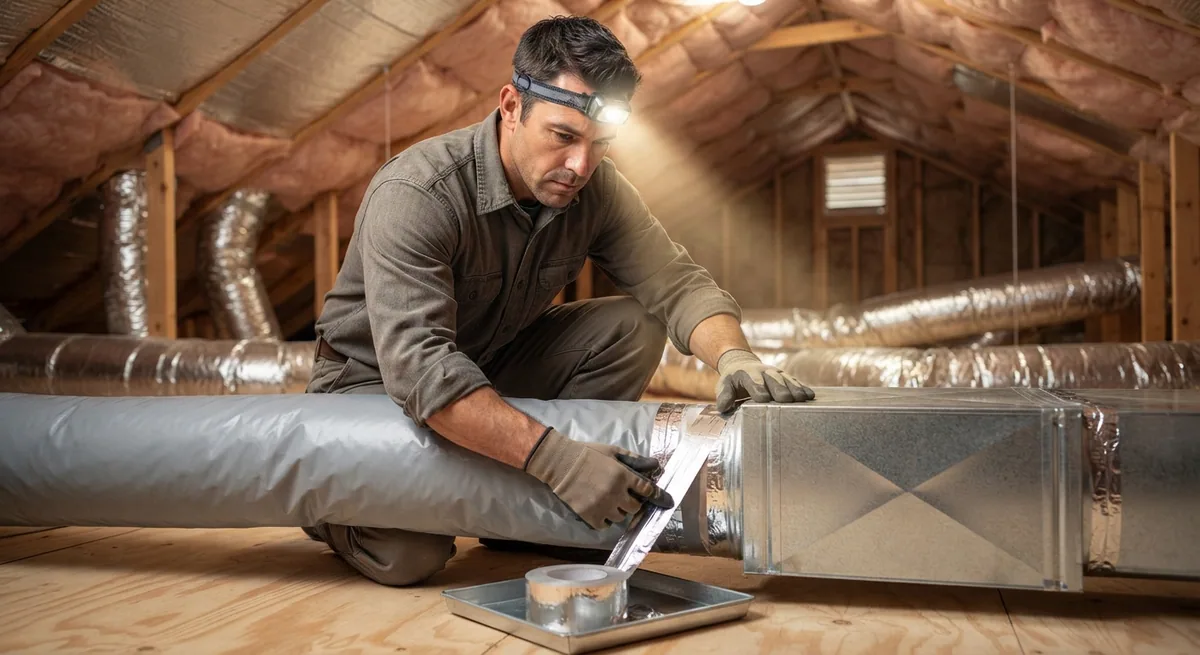
Quick Key Takeaways – Ductwork Services
Precision Ductwork Repair, Sealing, and Replacement in Saint George, Utah
When homeowners in Saint George, Utah, experience uneven indoor temperatures, spiking electric bills from Dixie Power, or rooms that remain stubbornly warm during 110-degree summer heat waves, their immediate reaction is often to blame the central air conditioner. However, in the vast majority of Southern Utah residences, the primary culprit is not the cooling equipment itself, but the air distribution system hidden inside the attic crawlspace. Your ductwork is the respiratory circulatory system of your home; even the most sophisticated, brand-new 20 SEER2 variable-speed air conditioner cannot deliver efficient comfort if 25 to 40 percent of its conditioned air leaks out into a superheated 145-degree desert attic before reaching living room registers.
As part of our comprehensive residential and commercial HVAC services, our field dispatch network coordinates precision ductwork repairs, aerodynamic mastic paste sealing, custom sheet metal fabrication, and R-8 insulation upgrades across Saint George, Washington, Santa Clara, Ivins, and Hurricane. We connect property owners with background-vetted, professional HVAC technicians who evaluate duct systems empirically, utilizing digital static pressure manometers, thermal imaging cameras, and duct leakage blower testing.
Whether your home suffers from persistent hot rooms in south-facing bedrooms, crushed or disconnected flex ducting in the attic, or whistling registers caused by excessive static pressure, our network delivers disciplined mechanical remediation. To understand how clean, sealed air distribution protects indoor breathing air, explore our indoor air quality solutions page, or review cooling diagnostic procedures on our air conditioning repair page.
The Mojave Desert Attic Reality: Why Ductwork Fails in Southern Utah
In the vast majority of Saint George residential construction—ranging from established neighborhoods in Bloomington to modern master-planned subdivisions in Little Valley and Washington Fields—ductwork is routed through unconditioned attic spaces beneath tile, metal, or asphalt shingle roofs. During a Southern Utah summer, attics become thermal ovens, creating severe mechanical and thermodynamic stresses:
1. The 140°F to 150°F Attic Thermal Burden
On a typical 108-degree afternoon in Washington County, solar radiant heat drives attic temperatures between 140 and 150 degrees Fahrenheit. Inside your air handler, your cooling system works tirelessly to produce crisp, 55-degree supply air:
- The Temperature Differential: This creates an immense 90-degree thermal differential between the air inside the duct and the hostile environment surrounding it.
- Thermal Conduction Through Substandard Insulation: Older homes in Saint George frequently feature outdated R-4 or R-6 flexible ductwork. Under a 90-degree temperature split, heat rapidly conducts through the thin insulation, warming the 55-degree air to 65 or 70 degrees before it ever exits the register into your bedroom.
- The Modern Standard: Utah energy conservation codes now mandate R-8 insulated ductwork in unconditioned attics to resist extreme radiant heat gain.
2. The Breakdown of Traditional Duct Tape
Despite its common name, standard adhesive-backed "duct tape" should never be used on HVAC ductwork. In Saint George's desert attics, sustained 145-degree heat and bone-dry air dry out the rubber-based adhesive within 2 to 3 years. The tape turns brittle, loses its grip, and falls away, leaving gaping seam separations at plenum junctions, branch takeoffs, and register boots. Professional technicians utilize heavy-duty fiberglass mesh tape coated with fiber-reinforced, non-toxic elastomeric mastic paste, which permanently cures into a flexible, airtight rubberized seal that will never dry out or crack.
3. Return Duct Air Infiltration and Red Sand Contamination
A leak in your home's return ductwork (the negative pressure side of your system) is even more damaging than a supply leak:
- Negative Pressure Sucking Attic Air: The return duct operates under suction. If a return plenum joint or attic flex duct separates, the system actively draws 145-degree, dusty attic air directly into your air handler cabinet.
- Coil and Blower Fouling: This superheated attic air is loaded with fine Dixie red sand dust, fiberglass insulation fibers, and attic allergens, rapidly coating the wet indoor evaporator coil in a muddy sludge, choking airflow, and causing sudden coil freeze-ups. Learn more on our AC maintenance service page.
4. Restricted Airflow and High Total External Static Pressure (TESP)
When flexible ductwork is improperly installed—featuring sharp 90-degree bends, kinked runs draped over ceiling joists, or excessive sagging—it creates severe friction resistance to airflow. High static pressure forces the indoor circulation blower motor to work against immense resistance, consuming excessive electrical wattage, generating loud air whistling at registers, and eventually burning out expensive electronically commutated motors (ECM).
4-Step Professional Ductwork Restoration Protocol
Technicians dispatched through our Saint George network follow a structured, scientific diagnostic and restoration protocol:
STATIC PRESSURE and THERMAL AUDIT → LEAK DETECTION → MASTIC PASTE SEALING → R-8 INSULATION UPGRADE and BALANCING
Step 1: Digital Static Pressure and Thermal Imaging Audit
The technician measures total external static pressure (TESP) across the indoor air handler using a digital differential manometer, comparing measured inches of water column (WC) to the equipment manufacturer's maximum rating (typically 0.50 to 0.80 inches WC). Using an infrared thermal camera, the technician scans ceiling drywall in living areas to identify cool air escaping into attic cavities or hot attic air bleeding into living zones.
Step 2: Physical Attic Crawlspace Inspection
The technician enters the attic to inspect every linear foot of trunkline, flexible branch run, and register connection, checking for:
- Torn outer vapor barriers and deteriorated insulation.
- Crushed, kinked, or improperly supported flex duct runs.
- Disconnected branch collars at the main sheet metal supply plenum.
- Air leakage around unsealed ceiling drywall register boots.
Step 3: Aerodynamic Mastic Paste Sealing
All accessible duct seams, collar takeoffs, elbow gores, and plenum connections are mechanically fastened with sheet metal screws and sealed with fiber-reinforced elastomeric mastic paste and fiberglass mesh. Technicians seal the critical gap between ceiling drywall and metal register boots, preventing hot attic air from being drawn into rooms through ceiling cuts.
Step 4: R-8 Insulation Upgrades and Airflow Balancing
Damaged, undersized, or degraded R-4 flex ducts are replaced with high-performance, smooth-core R-8 insulated flexible ducting, suspended with 1.5-inch wide strapping to prevent sagging or kinks. Technicians adjust manual branch balancing dampers to ensure proportional cubic feet per minute (CFM) air delivery to every room, eliminating hot spots.
Ductwork Diagnostic and Performance Comparison Matrix
The table below outlines common ductwork problems encountered across Saint George homes and their engineered solutions:
| Ductwork Failure Symptom | Physical Mechanical Root Cause | Diagnostic Tool Used | Professional Trade Remediation | Real-World Homeowner Benefit |
|---|---|---|---|---|
| South-Facing Bedroom Constantly Hot | Undersized flex duct; excessive friction from 90° bends | Digital Manometer and Anemometer (CFM) | Upsize branch run to R-8 flex; install aerodynamic sheet metal takeoff | Delivers adequate CFM airflow; eliminates room hot spot |
| Loud Air Whistling or Howling at Grilles | Excessive static pressure from undersized return duct | Differential Manometer Static Test | Cut in dedicated secondary return air grille and duct drop | Lowers static pressure; silences airflow noise; protects blower motor |
| Spiking Electric Bills, Unit Runs All Day | Major supply plenum separation in 145°F attic | Infrared Thermal Imaging Camera | Reconnect trunkline; fasten with zip ties and seal with mastic paste | Stops losing 30% of conditioned air; lowers monthly Dixie Power bills |
| Heavy Red Dust Coating Furniture Daily | Return duct disconnection pulling attic dust | Visual Attic Crawl and Static Audit | Mechanically reconnect return duct; seal all seams with fiberglass mesh | Stops attic dust infiltration; improves indoor air cleanliness |
| Musty, Hot Smell When AC First Kicks On | Unsealed ceiling register boots pulling attic air | Smoke Pencil Air Infiltration Test | Caulk and mastic seal drywall-to-metal boot gaps beneath register grilles | Eliminates attic odor infiltration; seals building envelope |
Custom Sheet Metal Fabrication Versus Flexible Ductwork
A durable, high-efficiency duct system combines rigid sheet metal trunklines with properly supported flexible branch runs:
Rigid Galvanized Sheet Metal Plenums
The main supply and return plenums attached directly to your furnace or air handler endure the highest static pressures and air velocities. Technicians custom-fabricate transition plenums from heavy-gauge galvanized sheet metal, ensuring smooth, aerodynamic transitions that eliminate air turbulence and static resistance. Rigid plenums are insulated externally with R-8 foil-faced fiberglass wrap to prevent sweating and condensation in humid laundry rooms or unconditioned attics.
High-Performance R-8 Flexible Ductwork
Flexible ducting is ideal for navigating complex attic framing to reach individual ceiling registers. However, flex duct must be installed with professional care:
- It must be pulled tight—any excess slack creates internal accordion ridges that increase airflow resistance by up to 40 percent.
- Hanger straps must be spaced at maximum 4-foot intervals to eliminate sagging.
- Bends must maintain a radius greater than the duct diameter to prevent severe airflow chokes.
Pairing an engineered duct system with a high-efficiency central system maximizes comfort. Explore complete system replacements on our air conditioning replacement page or analyze heating pairing on our furnace installation page.
Serving All Washington County Communities
Our ductwork repair and sealing specialists provide dedicated service across all local municipalities:
- Saint George, UT (84770, 84790): Bloomington, Little Valley, SunRiver, The Ledges, and Stone Cliff. Review our Saint George location page.
- Washington, UT (84780): Washington Fields, Coral Canyon, and Green Springs. Visit our Washington UT dispatch page.
- Santa Clara, UT (84765): Historic Santa Clara and elevated hillside subdivisions. Explore our Santa Clara UT page.
- Ivins, UT (84738): Snow Canyon corridor and Kayenta. Read our Ivins UT overview.
- Hurricane, UT (84737): Central Hurricane and Sky Mountain. Visit our Hurricane UT page.
Frequently Asked Questions About Ductwork Services
How do I know if my attic ductwork is leaking?
Common signs of duct leakage include unusually high summer electric bills, rooms that never cool down despite the AC running constantly, excessive red dust settling on furniture within days of cleaning, and a musty or hot dusty smell when the blower first turns on. A professional technician can perform a static pressure test or thermal camera audit to verify exact leakage points.
Why is R-8 insulation recommended for ductwork in Saint George?
In Saint George's desert climate, attic temperatures frequently reach 140 to 150 degrees Fahrenheit during peak summer afternoons. Older R-4 or R-6 insulated ductwork allows significant heat from the attic to conduct through the duct wall into the cold 55-degree supply air. Upgrading to R-8 insulation provides a robust thermal barrier that keeps conditioned air cold from the air handler all the way to your living room registers.
How much energy can duct sealing save?
According to the U.S. Department of Energy and energy research studies, sealing leaking ductwork in an unconditioned attic space can improve overall cooling and heating system efficiency by 20 to 35 percent. In Saint George, where summer air conditioning accounts for the majority of residential electric bills, professional mastic duct sealing delivers dramatic monthly savings.
Schedule a Professional Ductwork Assessment in Saint George Today
Stop losing expensive conditioned air into your superheated attic. Connect directly with our Saint George field dispatch desk to schedule an on-site ductwork inspection, static pressure test, and itemized written project estimate with an experienced, background-vetted technician.
Call our local dispatch desk today at (435) 348-8603, or submit your project details online through our contact page.
Dispatch Field Hotline
Connect directly with our local response coordinator to route a technician to your property.
(435) 348-8603Related Trade Services
Pricing Transparency
Review current regional parts and labor benchmarks across our comprehensive local pricing directory.
Explore HVAC Cost Guides →Our 4-Step HVAC Service Methodology
Engineered to guarantee rapid local response, empirical diagnostic accuracy, upfront pricing clarity, and code compliance.
Discovery and Dispatch
Direct telephone intake with our Saint George dispatch desk to record symptoms, assess thermal urgency, and route the nearest field unit directly to your property.
Empirical Diagnostic
Comprehensive physical, thermal, and electrical diagnostic testing of your cooling or heating system to pinpoint the root mechanical failure without guesswork.
Clear Project Estimate
We clearly explain our diagnostic findings and provide a transparent, itemized written estimate detailing scope and materials for your approval before starting work.
Precision Execution
Flawless repair or installation utilizing OEM parts, adherence to Utah mechanical codes, full thermodynamic testing, and thorough clean-up upon completion.
Speak Directly With Our Field Dispatch Desk
Connect immediately with our local Saint George response desk for prompt technician dispatch, empirical diagnostics, and clear project estimates.