Air Conditioning Maintenance in Saint George, UT
Prevent catastrophic mid-summer breakdowns, lower Dixie Power electric bills, and extend equipment lifespan with specialized desert cooling tune-ups.
Direct Field Dispatch
Connect directly with regional HVAC field technicians. Rapid emergency troubleshooting available.
(435) 348-8603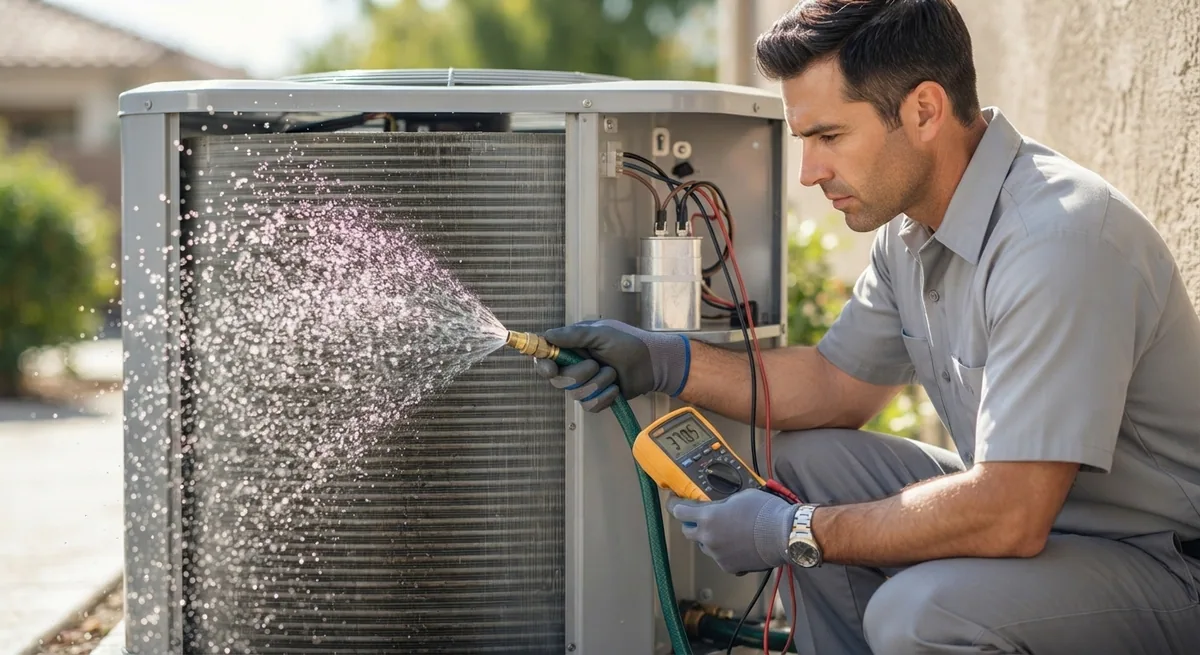
Quick Key Takeaways – AC Maintenance
Comprehensive Air Conditioning Maintenance in Saint George, Utah
In moderate climates across the United States, scheduling an annual air conditioning tune-up is often viewed as an optional home maintenance task. In Saint George, Utah, proactive preventative AC maintenance is critical mechanical insurance. Situated in the arid Mojave Desert basin, cooling systems in Washington County endure operational run-times and extreme ambient heat loads that far exceed national averages. When outdoor temperatures climb past 105 to 110 degrees Fahrenheit, an unmaintained air conditioner with dirty condenser coils, weakened capacitors, and restricted airflow will rapidly overheat, drawing excessive electrical amperage until it suffers catastrophic mechanical failure.
As part of our comprehensive residential and commercial HVAC services, our local dispatch desk coordinates thorough, multi-point preventative cooling tune-ups across Saint George, Washington, Santa Clara, Ivins, and Hurricane. Every tune-up is conducted by background-vetted, professional HVAC technicians who utilize empirical digital testing instruments to inspect, clean, calibrate, and verify every critical mechanical and electrical component.
By investing in professional seasonal maintenance before the brutal summer heat arrives, you eliminate unexpected breakdown anxiety, preserve valuable 10-year manufacturer parts warranties, and lower monthly electrical bills from Dixie Power or Saint George Energy Services. To learn more about common diagnostic procedures, visit our air conditioning repair service page, or explore comprehensive pricing breakdowns in our HVAC maintenance cost guide.
Why Saint George Desert Conditions Demand Specialized AC Tune-Ups
Standard cooling tune-up checklists designed for humid or temperate states are woefully inadequate for Southern Utah. The desert environment introduces aggressive environmental variables that require targeted mechanical remediation:
1. Removing Embedded Dixie Red Sand Dust From Condenser Fins
Saint George's distinctive red sandstone soil breaks down into ultra-fine, abrasive airborne dust. During seasonal windstorms, this fine dust is drawn directly through outdoor condensing units by high-CFM exhaust fan blades. Over months of operation, red sand settles deep between the microscopic aluminum coil fins, creating a dense, insulating blanket.
This dust layer prevents outdoor air from contacting the copper and aluminum coil surfaces, choking thermodynamic heat transfer. The compressor must work against severe head pressures—frequently spiking over 450 PSI on R-410A systems—which causes compressor motor windings to run at dangerously high temperatures. A standard garden hose rinse only pushes mud deeper into the coil; technicians utilize non-acidic foaming chemical coil cleaners that expand from the inside out, lifting embedded silt without damaging delicate aluminum fins.
2. Dielectric Fluid Breakdown in Electrical Capacitors
The outdoor control box of an air conditioning condenser sits exposed to direct desert sunlight, where metal enclosure temperatures routinely reach 140 to 160 degrees Fahrenheit. Electrical run capacitors contain specialized dielectric oils that break down under prolonged thermal exposure. As a capacitor degrades, its microfarad (MFD) rating drops.
When capacitance falls more than 10 percent below its rated specification, the compressor and outdoor fan motors struggle to maintain proper rotational speed, drawing excessive locked-rotor amps (LRA) and generating extreme internal friction. During a precision tune-up, technicians disconnect and test each capacitor with a calibrated digital multimeter, identifying microfarad loss and replacing weakened capacitors before they trigger catastrophic motor burnout during a heat wave.
3. Biological Algae and Dust Sludge in Condensate Lines
Even in an arid desert climate, a central air conditioning system extracts gallons of moisture from indoor air every day as warm room air passes across the cold evaporator coil. In Saint George, fine airborne dust that bypasses return air filters mixes with this condensed moisture, creating a thick, muddy sludge in the condensate drain pan.
In warm dark drain lines, biological algae and bacterial slime flourish, causing drain lines to back up completely. If an unmaintained condensate line clogs, water overflows the drain pan, ruining attic insulation, warping drywall ceilings, and creating expensive structural damage. Preventative maintenance includes pressure-flushing condensate lines with pressurized nitrogen and placing slow-release pan treatment tablets to prevent slime formation.
The 24-Point Precision Desert Cooling Maintenance Checklist
When a professional technician conducts an air conditioning tune-up through our network, they execute a comprehensive 24-point empirical inspection covering electrical, mechanical, thermodynamic, and airflow systems:
ELECTRICAL ANALYSIS → COIL CHEMICAL CLEANING → THERMODYNAMIC GAUGES → AIRFLOW and BLOWER → CONDENSATE CLEARING → CALIBRATION
Electrical and Safety Controls (Points 1–8)
- Capacitor Capacitance Testing: Testing start and run capacitors with digital multimeters to verify microfarads are within ±5% of factory ratings.
- Contactor Point Inspection: Checking magnetic contactor points for electrical pitting, carbon arcing, and insect debris.
- Compressor Amp Draw Analysis: Measuring compressor running amperage (RLA) against manufacturer specifications.
- Condenser Fan Motor Amps: Measuring outdoor fan motor current draw and checking motor shaft end-play.
- High-Voltage Disconnect Testing: Inspecting electrical disconnect box, terminal lug tightness, and fuse integrity.
- Safety Switch Verification: Testing high-pressure and low-pressure safety cutoffs to ensure compressor protection.
- Control Wiring Inspection: Checking low-voltage 24V control wiring for chafing, rodent damage, or loose wire nuts.
- Electrical Ground Continuity: Verifying proper equipment grounding to prevent electrical shock hazards.
Thermodynamic and Refrigeration Circuit (Points 9–14)
- Superheat and Subcooling Calculation: Connecting digital manifold gauges and pipe thermistors to calculate real-time thermodynamic performance.
- Refrigerant Level Verification: Confirming the system operates with the exact factory charge without overcharging or undercharging.
- Compressor Sound and Vibration Analysis: Listening for internal valve chatter, bearing rumble, or mechanical imbalance.
- Service Valve Inspection: Checking brass service ports and Schrader valve cores for microscopic refrigerant seepage.
- Liquid Line Filter Drier Check: Measuring temperature drop across the filter drier to detect internal desiccant restrictions.
- Thermal Expansion Valve (TXV) Operation: Verifying TXV sensing bulb insulation and superheat modulation stability.
Air Distribution and Indoor Air Handler (Points 15–20)
- Total External Static Pressure (TESP): Measuring return and supply static pressure with a differential digital manometer.
- Blower Wheel Inspection: Checking centrifugal blower wheel blades for dust accumulation that restricts CFM airflow.
- Indoor Blower Motor Testing: Measuring blower motor running amperage and checking ECM variable-speed communication.
- Indoor Evaporator Coil Inspection: Inspecting coil surface for microbial growth, dust fouling, or ice formation.
- Temperature Split Measurement: Testing supply air temperature versus return air temperature (targeting a 16°F to 21°F delta T).
- Air Filter Evaluation: Inspecting existing air filtration and advising on high-MERV upgrades to combat red sand dust.
Cleaning, Drainage and Thermostat Calibration (Points 21–24)
- Chemical Condenser Wash: Applying high-foaming coil cleaner to wash red sand dust and debris from outdoor fins.
- Condensate Drain Evacuation: Clearing condensate drain trap with high-pressure nitrogen and treating drain pan.
- Float Safety Switch Testing: Testing the primary and secondary float switches to verify automatic shutdown upon water backup.
- Thermostat Calibration and Cycle Test: Testing digital thermostat anticipator settings, temperature accuracy, and mode switching.
Maintenance ROI: Financial Benefits of Seasonal Servicing
Investing in seasonal cooling maintenance delivers immediate, quantifiable financial returns for Washington County homeowners:
| Financial Dimension | Maintained Air Conditioner | Neglected Air Conditioner | 5-Year Financial Impact |
|---|---|---|---|
| Monthly Summer Electric Bills | Peak SEER2 efficiency; compressor runs at optimal amp draws | 15% to 25% efficiency loss; compressor draws excessive power | Saves $600 to $1,200 in Dixie Power electricity over 5 summers |
| Emergency Repair Frequency | 90% of electrical failures caught and resolved proactively | Frequent mid-summer breakdown; emergency dispatch required | Prevents $800 to $2,500 in unexpected capacitor/motor repair bills |
| Equipment Service Lifespan | 12 to 15+ years of reliable desert operation | 8 to 10 years; premature compressor burnout from high heat | Delays $7,000 to $12,000 replacement investment by several years |
| Manufacturer Warranty Protection | Complies with annual maintenance clauses required by OEMs | Risk of denied warranty claims on compressor or coil replacement | Preserves full 10-year parts warranty coverage |
The Critical Role of Indoor Filtration and Ductwork
A precision outdoor tune-up must be supported by proper indoor airflow management. During a maintenance visit, technicians examine your air filtration and ductwork:
- Upgrading Beyond 1-Inch Fiberglass Filters: Standard 1-inch fiberglass filters capture only large pet hair and lint, allowing microscopic red sand dust to pass straight through onto your wet evaporator coil. Upgrading to whole-home 4-inch or 5-inch media filters dramatically improves dust capture. Explore our indoor air quality solutions.
- Attic Ductwork Inspection: Because attic temperatures in Saint George reach 140 to 150 degrees Fahrenheit, any duct leakage pulls superheated, dusty air directly into your conditioned living areas. Learn about professional mastic sealing on our ductwork repair service page.
- Comprehensive Annual Protection: For year-round peace of mind covering both summer cooling and winter heating, consider our structured HVAC maintenance plans.
Serving All Washington County Communities
Our preventative maintenance teams provide dedicated scheduling across all local municipalities:
- Saint George, UT (84770, 84790): Bloomington, Little Valley, SunRiver, The Ledges, and Stone Cliff. Review our Saint George location page.
- Washington, UT (84780): Washington Fields, Coral Canyon, and Green Springs. Visit our Washington UT dispatch page.
- Santa Clara, UT (84765): Historic Santa Clara and elevated hillside developments. Explore our Santa Clara UT page.
- Ivins, UT (84738): Snow Canyon corridor and Kayenta. Read our Ivins UT overview.
- Hurricane, UT (84737): Central Hurricane and Sky Mountain. Visit our Hurricane UT page.
Frequently Asked Questions About AC Maintenance
What is the best time of year to schedule AC maintenance in Saint George?
The ideal window for pre-season cooling maintenance in Southern Utah is during the spring months of March, April, and early May, before outdoor temperatures climb past 90 degrees Fahrenheit. Scheduling early ensures your system is thoroughly cleaned, tested, and operating at peak efficiency before the first major summer heat wave hits Washington County.
How often should I replace my air filters during a Saint George summer?
Due to high dust levels and long daily equipment run-times, standard 1-inch filters should be checked every 30 days and replaced at least every 60 days during peak summer. High-capacity 4-inch or 5-inch media filters should be inspected every 3 months and replaced every 6 to 9 months, depending on pet ownership and indoor dust accumulation.
Does professional maintenance really lower my electric bill?
Yes. Cleaning heavily fouled condenser coils and replacing a weakened run capacitor can lower your system's electrical power consumption by 15 to 25 percent. In Saint George's climate, where air conditioners run for hours each day, this efficiency restoration produces immediate, noticeable savings on monthly Dixie Power or Saint George Energy Services utility bills.
Schedule Your Precision AC Tune-Up Today
Do not wait for a complete cooling failure during a 110-degree heat wave to find out your air conditioner has a failing capacitor or clogged coils. Connect directly with our Saint George field dispatch desk to schedule a comprehensive, clean-tech 24-point preventative cooling tune-up.
Call us today at (435) 348-8603, or submit your appointment request online through our contact page.
Dispatch Field Hotline
Connect directly with our local response coordinator to route a technician to your property.
(435) 348-8603Related Trade Services
Pricing Transparency
Review current regional parts and labor benchmarks across our comprehensive local pricing directory.
Explore HVAC Cost Guides →Our 4-Step HVAC Service Methodology
Engineered to guarantee rapid local response, empirical diagnostic accuracy, upfront pricing clarity, and code compliance.
Discovery and Dispatch
Direct telephone intake with our Saint George dispatch desk to record symptoms, assess thermal urgency, and route the nearest field unit directly to your property.
Empirical Diagnostic
Comprehensive physical, thermal, and electrical diagnostic testing of your cooling or heating system to pinpoint the root mechanical failure without guesswork.
Clear Project Estimate
We clearly explain our diagnostic findings and provide a transparent, itemized written estimate detailing scope and materials for your approval before starting work.
Precision Execution
Flawless repair or installation utilizing OEM parts, adherence to Utah mechanical codes, full thermodynamic testing, and thorough clean-up upon completion.
Speak Directly With Our Field Dispatch Desk
Connect immediately with our local Saint George response desk for prompt technician dispatch, empirical diagnostics, and clear project estimates.