Air Conditioning Repair in Saint George, UT
Prompt on-site cooling diagnostics and repairs engineered for extreme Mojave Desert summer heat across Saint George and Washington County.
Direct Field Dispatch
Connect directly with regional HVAC field technicians. Rapid emergency troubleshooting available.
(435) 348-8603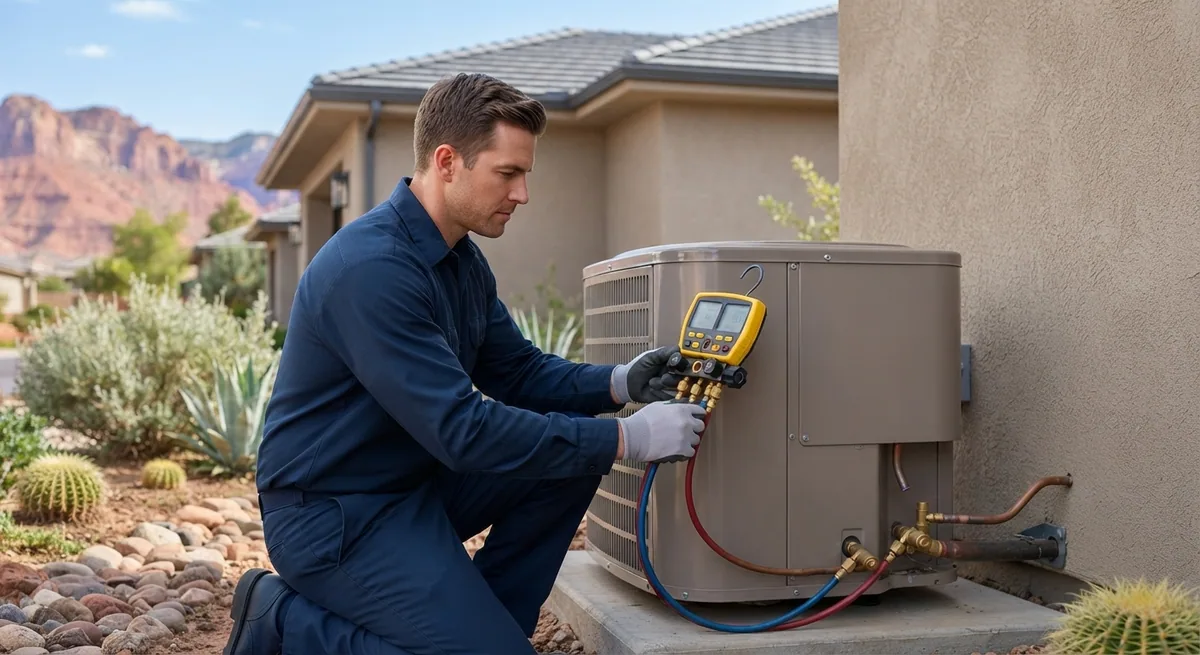
Quick Key Takeaways – Air Conditioning Repair
Precision Air Conditioning Repair in Saint George, Utah
When an air conditioning system fails in Saint George during the height of summer, the breakdown represents far more than an inconvenience. With outdoor temperatures routinely climbing past 105 degrees Fahrenheit—and peak heat waves pushing between 110 and 115 degrees Fahrenheit—indoor residential temperatures can reach dangerous levels within just a few hours. In Southern Utah's arid Mojave Desert basin, air conditioning is essential safety equipment. When your cooling system stops blowing cold air, begins short-cycling, or makes loud metallic clattering noises, you need rapid, technically disciplined diagnostic support.
As part of our comprehensive residential and commercial trade services, our local dispatch desk routes background-vetted, professional HVAC technicians directly to properties across Saint George, Washington, Santa Clara, Ivins, and Hurricane. Every technician arrives equipped with calibrated digital testing instruments, true-RMS multimeters, and high-ambient replacement components to isolate the root failure cause accurately and restore cooling performance without delay.
If your cooling equipment has suffered a catastrophic mechanical failure or is approaching 15 years of age, you can also review modern equipment options on our air conditioning replacement page or consult our detailed air conditioning repair cost guide to review regional parts and labor pricing.
Why Air Conditioners Break Down in Saint George's Desert Climate
Air conditioners in Washington County endure thousands of operating hours under punishing ambient conditions that push mechanical, electrical, and thermodynamic components far past their standard design limits. Understanding why cooling systems fail locally helps homeowners identify warning signs early:
1. Dielectric Breakdown in Electrical Run Capacitors
The dual run capacitor is the single most common component to fail during a Saint George summer. Capacitors store electrical energy to supply the continuous phase-shifted voltage necessary to keep compressor and outdoor fan motors running smoothly. Outdoor electrical control compartments in direct sunlight can easily reach internal temperatures of 140 to 160 degrees Fahrenheit. Under this intense heat, the dielectric fluid inside standard capacitors degrades rapidly. When capacitance drops by more than 10 percent of its rated microfarad (MFD) value, compressor and fan motors draw excessive electrical amperage, overheat, and trip circuit breakers or suffer permanent motor winding burnout.
2. High Head Pressure and Severe Thermal Saturation
To cool your home, an air conditioner must compress low-pressure vapor refrigerant into a superheated, high-pressure gas and pump it through the outdoor condenser coil, where outdoor air absorbs the heat and allows the refrigerant to condense into a liquid. When outdoor ambient temperatures exceed 108 degrees Fahrenheit, the temperature differential between outdoor air and the condensing refrigerant narrows drastically. The compressor must operate under extreme head pressures (often exceeding 425 to 475 PSI on modern R-410A systems), generating massive internal mechanical friction and heat. Without proactive pre-season maintenance, detailed on our AC maintenance service page, compressors frequently trip on internal thermal overload safety switches.
3. Dixie Red Sand Dust Fouling
Saint George's famous red rock sandstone produces microscopic, highly abrasive dust particles that become airborne during desert wind events. When drawn into outdoor condenser coils, red sand accumulates tightly between the delicate aluminum fins, creating an insulating barrier that restricts airflow and halts thermodynamic heat rejection. Inside the home, fine red dust that slips past basic 1-inch filters coats the wet surfaces of the indoor evaporator coil, choking airflow, starving the compressor of return refrigerant gas, and triggering sudden coil freeze-ups.
4. Thermal Expansion Valve (TXV) Metering Failures
The thermal expansion valve regulates the exact volume of liquid refrigerant entering the indoor evaporator coil. In desert conditions, extreme thermal cycling, acid formation from overheated compressor oil, and moisture contamination can cause the internal needle and seat of the TXV to stick. A stuck-closed TXV starves the indoor coil, causing system freezing and a loss of cooling, while a stuck-open valve floods liquid refrigerant back into the compressor, causing catastrophic hydraulic mechanical failure.
Symptoms of AC Failure: When to Request Field Service
Do not wait for a complete system shutdown to contact a professional. Addressing mechanical symptoms early prevents minor electrical component failures from cascading into expensive compressor replacements:
- Warm Air Blowing From Supply Registers: If the indoor blower is running and moving air through your ceiling vents, but the air feels room-temperature or warm, the outdoor condensing unit has likely failed to start due to a defective capacitor, pitted contactor, blown fuse, or compressor failure.
- Ice Accumulation on Copper Refrigerant Lines: If you see white frost or solid ice coating the insulated suction line outside or the indoor coil cabinet, your system has suffered an acute airflow blockage or a thermodynamic refrigerant leak. Review our troubleshooting guide on why your AC is blowing warm air in Utah for emergency shut-off steps.
- Rapid Short-Cycling (Turning On and Off Every Few Minutes): When an air conditioner starts, runs for 2 to 4 minutes, and abruptly shuts down before satisfying the thermostat, high-pressure safety switches or low-pressure cutoff sensors are activating to protect the compressor from burnout.
- Loud Grinding, Screeching, or Buzzing Noises: A loud electrical buzzing sound from the outdoor unit indicates a jammed compressor rotor or a contactor coil humming under low voltage. A high-pitched metallic squeal signals failing sleeve bearings in the outdoor condenser fan motor.
- Water Leaking Around the Indoor Air Handler: In Saint George's dry climate, air conditioners still pull substantial moisture from indoor air. If algae growth or red dust sludges the condensate drain line, water overflows the drain pan, activating float safety switches or dripping through ceiling drywall.
Empirical 6-Step AC Diagnostic and Repair Workflow
Professional technicians dispatched through our network never rely on guesswork or superficial visual inspections. Every repair follows a structured empirical diagnostic protocol:
SYSTEM ASSESSMENT → ELECTRICAL MULTIMETER TESTING → REFRIGERANT GAUGES → THERMAL IMAGING → WRITTEN ESTIMATE → OEM REPAIR
Step 1: Electrical and Safety Inspection
The technician inspects the high-voltage disconnect box, fuses, electrical whips, and main panel breakers. Using a true-RMS multimeter, the technician measures line voltage and control circuit voltage (24V) to confirm clean electrical supply to the system.
Step 2: Capacitor and Contactor Analysis
The technician discharges and tests all single and dual run capacitors with a digital capacitance meter, comparing measured microfarads to manufacturer specifications. The heavy-duty magnetic contactor points are inspected for electrical pitting, carbon scoring, and insect intrusion.
Step 3: Refrigerant Thermodynamic Evaluation
Utilizing calibrated digital manifold gauges and pipe temperature clamps, the technician measures high-side and low-side pressures, calculating real-time superheat and subcooling. This empirical calculation verifies whether the system has the exact factory refrigerant charge or is suffering from a leak or metering valve restriction.
Step 4: Airflow and Static Pressure Testing
The technician measures total external static pressure (TESP) across the indoor evaporator coil and air distribution system using a digital differential manometer. This test confirms whether the blower motor is delivering rated cubic feet per minute (CFM) or if ductwork restrictions are choking the cooling cycle.
Step 5: Itemized Written Estimate
Following diagnostic testing, the technician explains the exact root cause of failure and presents an itemized, clear written estimate detailing all necessary parts, materials, and labor before any physical repair begins. You maintain complete control over the authorized scope of work.
Step 6: Precision Execution and Operational Verification
Upon receiving your written approval, the technician executes the repair utilizing high-grade OEM or heavy-duty high-ambient replacement components. Following part installation, the system is tested through a complete operational cycle, verifying proper temperature split (delta T) and electrical amp draws.
Common AC Repairs: Diagnostic Comparison Matrix
The table below outlines common air conditioning repair scenarios encountered across Saint George and Washington County:
| Failure Symptom | Defective Component | Root Cause in Desert Environment | Empirical Verification Tool | Typical Repair Procedure |
|---|---|---|---|---|
| Outdoor Fan Runs, Compressor Hums Loudly | Dual Run Capacitor | Thermal degradation from 150°F control box heat | Digital Multimeter MFD Test | Install heavy-duty high-temp 440V run capacitor; test compressor LRA |
| Complete System Dead, Thermostat Blank | Condensate Float Switch / 24V Transformer | Clogged drain line from algae and desert dust | Continuity Tester / Manometer | Clear drain line with nitrogen blow-out; replace blown 3A control fuse |
| Outdoor Fan Not Spinning, Motor Extremely Hot | Condenser Fan Motor | Bearing seizure from abrasive red sand dust | Ohmmeter Motor Winding Resistance | Replace with high-ambient ball-bearing OEM condenser fan motor |
| Compressor Running Non-Stop, Poor Cooling | Low Refrigerant Charge (Leak) | Vibration stress crack on copper coil hairpin | Electronic Halogen Sniffer / Ultrasonic | Isolate leak, recover refrigerant, nitrogen braze, vacuum to 500 microns, recharge |
| AC Runs 3 Minutes and Shuts Down | High-Pressure Limit Switch | Severely fouled condenser coil fins | Digital Gauge Manifold PSI Reading | Perform deep chemical foaming wash of condenser coil; restore airflow |
| Clicking Sound From Outdoor Unit, No Start | Electrical Contactor | Carbon arcing on contact points, ant intrusion | Voltage Drop Test across Points | Replace pitted contactor with sealed-pole heavy-duty contactor assembly |
Repair Versus Replacement: Navigating the Decision
When faced with a major air conditioning breakdown, homeowners must evaluate whether investing in repairs makes sound financial sense or if replacing the equipment is the more responsible path:
When Repair Makes Sense
- The System Is Under 10 Years Old: If the equipment is relatively modern, well-maintained, and utilizes environmentally compliant R-410A refrigerant, replacing an electrical component (such as a capacitor, contactor, or fan motor) restores dependable performance for years to come.
- The Repair Cost Is Manageable: If the repair cost is a fraction of the unit's value and the compressor and heat exchange coils remain in sound mechanical condition, proceeding with repairs is the logical choice.
- Equipment History Shows Consistent Care: If the system has received regular bi-annual tune-ups and has not suffered chronic, repeated breakdowns, repairing the specific failing part is recommended.
When System Replacement Is the Smarter Investment
- Equipment Exceeds 12 to 15 Years of Age: In Saint George's punishing climate, cooling systems operating past 12 years have absorbed immense thermal wear. Ongoing repairs often become a cycle of diminishing returns.
- Obsolete R-22 Freon Systems: If your older unit operates on phased-out R-22 refrigerant and has suffered a major refrigerant leak or compressor failure, virgin R-22 is prohibitively expensive and scarce. Modernizing to a high-efficiency system operating on compliant refrigerants is strongly advised.
- Catastrophic Compressor Burnout: A grounded or mechanically locked compressor is the most expensive single component in an air conditioner. When an older compressor fails out of warranty, the cost of a new compressor, filter driers, acid flush, and refrigerant recharge frequently approaches the cost of a modern, warranty-backed system. Review replacement dynamics in our air conditioning replacement guide.
Serving All Washington County Neighborhoods
Our dispatch coordinators route qualified cooling technicians across all local communities:
- Saint George, UT (84770, 84790): Downtown, Bloomington, Little Valley, SunRiver, The Ledges, Stone Cliff, and Green Valley. Visit our Saint George location page.
- Washington, UT (84780): Washington Fields, Coral Canyon, and Green Springs. Review our Washington UT dispatch page.
- Santa Clara, UT (84765): Historic Santa Clara and elevated hillside developments. Explore our Santa Clara UT page.
- Ivins, UT (84738): Snow Canyon corridor and Kayenta. Read our Ivins UT overview.
- Hurricane, UT (84737): Central Hurricane and Sky Mountain. Visit our Hurricane UT page.
Frequently Asked Questions About AC Repair
How quickly can a technician arrive for an emergency AC repair?
During severe Southern Utah heat waves, our dispatch desk prioritizes active cooling breakdowns. Field technicians stationed throughout Saint George, Washington, and Santa Clara are routed directly to your home, typically arriving promptly within agreed-upon service windows to resolve thermal emergencies.
Can I run my air conditioner if the copper line is frozen?
No. Operating an air conditioner with ice on the copper suction line or indoor coil can cause severe, permanent damage to the compressor. Liquid refrigerant that cannot boil in the frozen evaporator coil flows directly back to the compressor, causing hydraulic mechanical failure. Turn the system to "OFF" at the thermostat and switch the fan setting to "ON" to thaw the coil while you wait for your technician.
Do technicians carry replacement parts on their service vehicles?
Yes. Field service vehicles are stocked with high-demand universal replacement components, including heavy-duty dual run capacitors, high-ambient condenser fan motors, contactors, digital thermostats, hard start kits, electrical fuses, and common safety switches to complete the vast majority of repairs on the initial visit.
Schedule Professional AC Repair in Saint George Today
Do not let a malfunctioning air conditioner endanger your family's safety or comfort during a Southern Utah heat wave. Connect directly with our Saint George field dispatch desk to schedule a prompt on-site diagnostic assessment.
Call us now at (435) 348-8603 for immediate phone intake, or submit your service request online through our contact page.
Dispatch Field Hotline
Connect directly with our local response coordinator to route a technician to your property.
(435) 348-8603Related Trade Services
Pricing Transparency
Review current regional parts and labor benchmarks across our comprehensive local pricing directory.
Explore HVAC Cost Guides →Our 4-Step HVAC Service Methodology
Engineered to guarantee rapid local response, empirical diagnostic accuracy, upfront pricing clarity, and code compliance.
Discovery and Dispatch
Direct telephone intake with our Saint George dispatch desk to record symptoms, assess thermal urgency, and route the nearest field unit directly to your property.
Empirical Diagnostic
Comprehensive physical, thermal, and electrical diagnostic testing of your cooling or heating system to pinpoint the root mechanical failure without guesswork.
Clear Project Estimate
We clearly explain our diagnostic findings and provide a transparent, itemized written estimate detailing scope and materials for your approval before starting work.
Precision Execution
Flawless repair or installation utilizing OEM parts, adherence to Utah mechanical codes, full thermodynamic testing, and thorough clean-up upon completion.
Speak Directly With Our Field Dispatch Desk
Connect immediately with our local Saint George response desk for prompt technician dispatch, empirical diagnostics, and clear project estimates.