Heating Repair in Saint George, UT
Prompt on-site heating diagnostics and repairs engineered for freezing Southern Utah desert winter nights across Washington County.
Direct Field Dispatch
Connect directly with regional HVAC field technicians. Rapid emergency troubleshooting available.
(435) 348-8603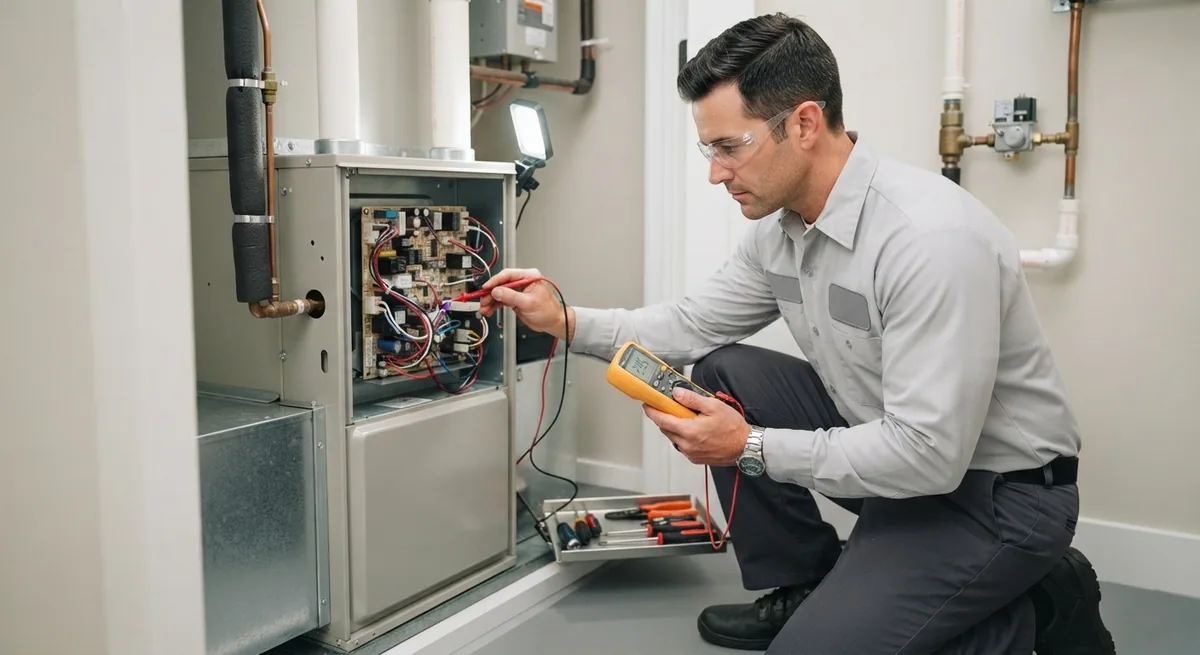
Quick Key Takeaways – Heating Repair
Dependable Heating Repair in Saint George, Utah
While Southern Utah is universally celebrated for its mild winter sunshine and red rock vistas, residents of Saint George understand that winter nights present a stark thermodynamic reality. Situated in a high desert basin, Washington County experiences rapid diurnal temperature swings. Once the sun dips behind the Red Mountain cliffs, ambient outdoor temperatures plummet quickly, routinely dropping into the 20s and low 30s Fahrenheit between late November and February. When a heating system malfunctions during a freezing desert night, an indoor residential space can become uncomfortably cold and hazardous to plumbing pipes within hours.
As part of our comprehensive residential and commercial HVAC services, our local dispatch network coordinates prompt, disciplined heating repairs across Saint George, Washington, Santa Clara, Ivins, and Hurricane. Every service call is handled by background-vetted, professional HVAC technicians who possess deep diagnostic expertise across all primary heating platforms, including natural gas furnaces, high-efficiency heat pumps, dual-fuel hybrid systems, and electric air handlers.
Whether your heat pump is blowing cold air, your gas furnace is clicking repeatedly without igniting, or your blower motor is making loud grinding sounds, our network delivers empirical diagnostics, clear written estimates, and clean-tech property protection. If your heating equipment relies on natural gas, review our specialized furnace repair service page, or explore comprehensive pricing benchmarks in our furnace repair cost guide.
Southern Utah Winter Climate Dynamics: Why Heating Systems Fail
Heating systems in Saint George endure a unique operational pattern. Because the cooling season dominates the year from May through October, residential heating equipment sits idle inside dusty attics, garages, or mechanical closets for six to eight months. When property owners finally activate their thermostats on the first freezing November evening, accumulated red sand dust, oxidized electrical terminals, and seized mechanical components frequently trigger sudden system failures.
1. Inactivity and Dust Accumulation on Burners and Ignitors
During the extended desert summer, fine red sand dust and household lint settle onto gas furnace burner orifices, hot surface ignitors, and pilot assemblies. When the thermostat calls for heat, this accumulated dust layer can impede the smooth flow of natural gas across the burner manifold, causing delayed ignition (a frightening "boom" sound) or preventing the ignitor from reaching the 2,000-degree Fahrenheit threshold required to ignite gas cleanly.
2. Oxidation on Flame Rectification Sensors
In gas furnaces, the flame sensor is a critical safety rod positioned in the burner path. When burners ignite, the flame creates a micro-amp DC electrical current that flows through the flame to ground (flame rectification), signaling to the integrated control board that fire is safely present. Over months of dormancy, microscopic oxidation and silica dust coat the stainless steel sensor rod. When the furnace starts, the sensor fails to detect the flame current within 4 seconds, causing the control board to shut off the gas valve as a safety lockout. If your furnace ignites for three seconds and abruptly shuts off, dirty flame sensors are the primary culprit.
3. Heat Pump Defrost Board and Reversing Valve Failures
In all-electric homes across Saint George and Washington City, heat pumps provide winter heating by extracting heat from outdoor air. When outdoor temperatures drop below 40 degrees Fahrenheit with elevated winter humidity, moisture condenses on the outdoor coil and freezes into frost. The heat pump must periodically enter a "defrost cycle" to melt this ice, temporarily reversing the refrigeration cycle and engaging indoor electric auxiliary heat strips. If the outdoor defrost thermostat, ambient air sensor, or defrost control board fails, the outdoor coil encases itself in solid ice, crushing aluminum fins and completely halting heat production. Learn more about reversible system diagnostics on our heat pump repair page.
4. Blower Motor Capacitor and Bearing Seizures
Indoor blower motors operate during both summer cooling and winter heating cycles. A blower motor that struggled through thousands of hours of 105-degree summer operation often suffers from dried bearing lubricants and a weakened run capacitor. When winter heating begins, the additional thermal heat rising from the furnace heat exchanger or electric heat strip elements places extra strain on the motor. If the blower fails to start, heat builds up rapidly inside the cabinet, tripping high-temperature limit switches and shutting down the system.
Common Heating Symptoms: When to Request Field Dispatch
Heating breakdowns present clear operational warning signs. Contacting a professional technician at the first sign of trouble prevents minor sensor issues from turning into emergency heating failures:
- Furnace Ignites, Burns for 3 to 5 Seconds, and Shuts Down: This is the classic signature of an oxidized flame rectification sensor or a grounding circuit fault. The system will attempt this cycle three times before entering a hard 1-hour control board lockout.
- Blower Runs Continuously, But Air Feels Cool or Lukewarm: In a heat pump system, lukewarm air often indicates a stuck reversing valve, a low refrigerant charge, or burned-out auxiliary electric heat strips. In a gas furnace, cool air indicates the limit switch has tripped, keeping the blower running to cool the heat exchanger while fuel flow is disabled.
- Loud Grinding, Screeching, or Scraping Sounds: A high-pitched metallic screech indicates failing sleeve bearings on the draft inducer blower motor (which vents combustion gases) or the main indoor circulation blower.
- Frequent System Short-Cycling (Turning On and Off Rapidly): If your heating system fires for only 2 to 3 minutes before shutting down, it is almost certainly overheating due to a severely clogged return air filter, blocked supply registers, or an improperly calibrated high-limit safety switch.
- Unusual Chemical or Burning Odors: While a slight dusty burning smell is normal during the first 15 minutes of operating your heater in the fall, a sharp electrical, plastic, or metallic burning odor signals melting wire insulation, overheated electric heat strips, or a motor bearing seizing.
5-Step Empirical Heating Diagnostic and Repair Protocol
Technicians dispatched through our Saint George network never guess. Every heating repair call follows a rigorous 5-step diagnostic process to ensure complete operational safety and code compliance:
SAFETY and ELECTRICAL VERIFICATION → COMBUSTION / REFRIGERATION TESTING → LIMIT SWITCH AUDIT → WRITTEN ESTIMATE → OEM REPAIR
Step 1: Safety and Electrical Diagnostic
The technician verifies incoming line voltage, checks control transformer output (24VAC), tests low-voltage fuses, and evaluates the main electrical disconnect. For heat pumps, start and run capacitors are tested with a digital multimeter for microfarad loss.
Step 2: Combustion and Ventilation Analysis (Gas Systems)
For gas furnaces, the technician inspects the draft inducer blower motor, measures combustion chamber draft with a digital manometer, tests static pressure safety switches, and verifies that the flue vent pipe is clear of bird nests, debris, or thermal separation in the attic.
Step 3: High-Resolution Heat Exchanger Camera Inspection
Safety is paramount. Using a specialized flexible fiber-optic borescope camera, the technician inspects internal heat exchanger curved cells and crimped seams for microscopic stress cracks, rust perforations, or metal fatigue that could allow lethal carbon monoxide gas to contaminate household breathing air.
Step 4: Safety Limit Circuit Audit
The technician tests the primary high-limit switch, roll-out safety switches, auxiliary limit switches, and flame sensors to verify that all factory safety cutoffs will immediately kill gas flow if the unit overheats or experiences flame rollout.
Step 5: Itemized Written Estimate and Precision Repair
The technician presents an itemized written estimate detailing all necessary replacement parts, materials, and labor before initiating any repairs. Following your written authorization, the technician installs OEM-grade components, tests gas manifold pressure with a digital manometer, verifies supply air temperature rise, and conducts carbon monoxide testing throughout living zones.
Heating Systems Diagnostic Comparison Matrix
The table below outlines common heating repair scenarios encountered across Saint George and Washington County:
| Observed Symptom | Primary Failing Component | Root Mechanical Cause | Diagnostic Tool Used | Professional Repair Procedure |
|---|---|---|---|---|
| Furnace Clicks 3 Times, Never Lights | Hot Surface Ignitor (HSI) | Silicon carbide element fractured from thermal shock | Digital Multimeter Ohmmeter | Install durable silicon nitride universal ignitor; verify voltage |
| Heater Lights 4 Seconds, Turns Off | Flame Rectification Sensor | Silica dust and carbon oxidation on stainless rod | Micro-amp DC Meter Reading | Polish sensor to bare metal; verify control board grounding |
| High-Pitched Squeal Before Ignition | Draft Inducer Blower Motor | Desert dust infiltration into motor sleeve bearings | Amp Clamp and Vibration Check | Replace draft inducer assembly and high-temp gasket seal |
| Heat Pump Blowing Cold Air in Winter | Defrost Control Board / Thermistor | Stuck in defrost cycle or failed ambient air thermistor | Temperature Probe Delta T Test | Replace defective defrost board; test reversing valve solenoid |
| Furnace Shuts Off After 3 Minutes | Primary High-Limit Switch | Clogged air filter choking airflow; overheating exchanger | Temperature Probe and Manometer | Replace high-MERV filter, test limit switch continuity, verify CFM |
| No Heat, 24V Control Fuse Blown | Contact Short in Low-Voltage Line | Chafed thermostat wiring or shorted gas valve solenoid | Multimeter Continuity Test | Trace low-voltage wiring, isolate short, replace 3A fuse |
Furnace Heat Exchanger Safety: Carbon Monoxide Defense
In natural gas heating systems, the heat exchanger is the thin metal barrier that separates toxic combustion gases (containing carbon monoxide, nitrogen dioxide, and water vapor) from the breathable indoor air circulating through your home's ductwork.
In Saint George's desert climate, heat exchangers endure aggressive thermal cycling:
- Attics and garages can drop to 25 degrees Fahrenheit at night. When a furnace fires, the heat exchanger expands rapidly from 25 degrees to over 500 degrees Fahrenheit in a matter of seconds.
- Over 12 to 18 years of continuous expansion and contraction, the metal fatigues, frequently developing hairline cracks along burner seams or radiator crimps.
- If a heat exchanger cracks, the indoor blower forces air into the burner compartment, causing flame rollout and blowing toxic carbon monoxide directly into bedroom and living room air registers.
Technicians dispatched through our network never compromise on life safety. If a cracked heat exchanger is verified via borescope camera, the gas supply is safely locked out, and the technician provides clear options for heat exchanger replacement or system modernization, referencing data in our furnace installation overview.
Serving All Washington County Communities
Our heating repair teams provide prompt, dedicated service across all local municipalities:
- Saint George, UT (84770, 84790): Bloomington, Little Valley, SunRiver, The Ledges, and Stone Cliff. Review our Saint George location page.
- Washington, UT (84780): Washington Fields, Coral Canyon, and Green Springs. Visit our Washington UT dispatch page.
- Santa Clara, UT (84765): Historic Santa Clara and elevated hillside subdivisions. Explore our Santa Clara UT page.
- Ivins, UT (84738): Snow Canyon corridor and Kayenta. Read our Ivins UT overview.
- Hurricane, UT (84737): Central Hurricane and Sky Mountain. Visit our Hurricane UT page.
Frequently Asked Questions About Heating Repair
Why does my heater smell like burning dust when I first turn it on in the fall?
In Saint George, heating systems sit completely idle for six to eight months during the long summer. During this time, fine airborne red sand dust and household lint settle directly onto gas burners, electric heating coils, and heat exchanger surfaces. When the system fires for the first time, this accumulated dust safely burns off, creating a temporary odor that should completely dissipate within 20 to 30 minutes. If the smell persists or smells like melting plastic or electrical wiring, shut the system off immediately.
What should I do if my carbon monoxide alarm sounds?
If your carbon monoxide detector sounds, treat it as an immediate life-safety emergency. Evacuate all occupants and pets from the home immediately, leave doors open behind you to ventilate the space, and call local emergency services (911) or your gas utility provider from a safe distance outside. Do not re-enter the home until emergency personnel declare the atmosphere safe.
Can an aging heat pump effectively heat my Saint George home during freezing weather?
Yes, modern heat pumps provide reliable heating in Saint George's climate down to freezing temperatures. However, older standard heat pumps lose thermodynamic efficiency when outdoor temperatures drop below 35 degrees Fahrenheit, requiring internal auxiliary electric heat strips to maintain indoor setpoints. Upgrading to a modern variable-speed inverter heat pump delivers robust heating capacity down to 15 degrees Fahrenheit without relying heavily on expensive electric heat strips.
Schedule Prompt Heating Repair in Saint George Today
Do not spend another freezing winter night in Southern Utah with a malfunctioning heating system. Connect directly with our Saint George field dispatch desk to schedule an empirical on-site diagnostic assessment with an experienced, background-vetted technician.
Call us today at (435) 348-8603, or submit your project details online through our contact page.
Dispatch Field Hotline
Connect directly with our local response coordinator to route a technician to your property.
(435) 348-8603Related Trade Services
Pricing Transparency
Review current regional parts and labor benchmarks across our comprehensive local pricing directory.
Explore HVAC Cost Guides →Our 4-Step HVAC Service Methodology
Engineered to guarantee rapid local response, empirical diagnostic accuracy, upfront pricing clarity, and code compliance.
Discovery and Dispatch
Direct telephone intake with our Saint George dispatch desk to record symptoms, assess thermal urgency, and route the nearest field unit directly to your property.
Empirical Diagnostic
Comprehensive physical, thermal, and electrical diagnostic testing of your cooling or heating system to pinpoint the root mechanical failure without guesswork.
Clear Project Estimate
We clearly explain our diagnostic findings and provide a transparent, itemized written estimate detailing scope and materials for your approval before starting work.
Precision Execution
Flawless repair or installation utilizing OEM parts, adherence to Utah mechanical codes, full thermodynamic testing, and thorough clean-up upon completion.
Speak Directly With Our Field Dispatch Desk
Connect immediately with our local Saint George response desk for prompt technician dispatch, empirical diagnostics, and clear project estimates.