Air Conditioning Installation in Saint George, UT
Precision-engineered cooling system installations and modernizations designed to withstand extreme Mojave Desert heat across Washington County.
Direct Field Dispatch
Connect directly with regional HVAC field technicians. Rapid emergency troubleshooting available.
(435) 348-8603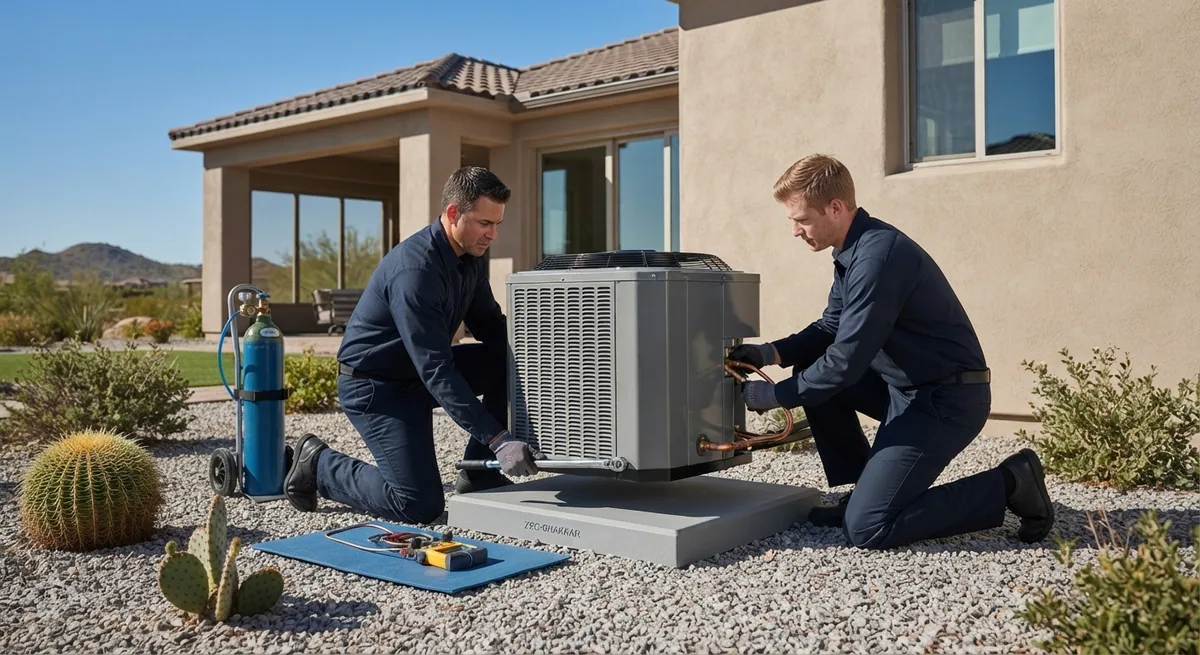
Quick Key Takeaways – AC Installation
Precision Air Conditioning Installation in Saint George, Utah
Investing in a new central air conditioning system for a home or commercial building in Saint George, Utah, is one of the most critical structural and financial decisions a property owner can make. In Washington County's intense desert climate, cooling equipment cannot simply be selected off a generic sizing chart. With summer temperatures regularly climbing between 105 and 115 degrees Fahrenheit, an incorrectly sized, poorly matched, or improperly commissioned air conditioner will struggle from its very first day of operation, driving electrical bills from Dixie Power or the City of Saint George to unprecedented heights while failing to maintain indoor comfort.
As part of our comprehensive residential and commercial HVAC services, our local dispatch network connects property owners with vetted, professional HVAC installation specialists. Every installation is engineered from the ground up utilizing strict scientific protocols, including computerized Manual J load calculations, Manual D ductwork evaluations, and Department of Energy Southwest regional SEER2 compliance standards.
Whether you are completing a custom home build in Little Valley, retrofitting an existing property in Bloomington, or upgrading an aging system that has reached the end of its useful lifespan, our network ensures your new cooling equipment delivers maximum thermodynamic efficiency, whisper-quiet operation, and long-term durability. To understand equipment acquisition costs, labor scopes, and regional utility incentives, explore our detailed AC installation cost guide, or review our emergency troubleshooting support on our air conditioning repair page.
The Science of Sizing: Why Manual J Load Calculations Are Critical
In decades past, less experienced contractors frequently sized air conditioners using crude rules of thumb, such as allocating "one ton of cooling per 500 square feet." In the extreme desert climate of Saint George, rule-of-thumb sizing leads directly to chronic comfort failures, premature compressor breakdown, and excessive energy consumption.
The Dangers of an Oversized Air Conditioner
Many homeowners assume that installing a larger air conditioner guarantees superior cooling. In reality, an oversized system is a disaster for indoor comfort:
- Severe Short-Cycling: An oversized unit blasts living spaces with cold air too rapidly, satisfying the thermostat in 5 to 8 minutes. Because the system shuts down so quickly, it never runs long enough to pull latent moisture from the air or establish steady-state thermodynamic cooling.
- Extreme Temperature Spikes and Hot Spots: Short bursts of cooling create harsh temperature stratification, leaving rooms with southern or western exposures uncomfortably hot while interior hallways feel chilly.
- Accelerated Mechanical Wear: Starting and stopping places the highest electrical and mechanical stress on compressor motor windings, capacitors, and contactors. Frequent short-cycling drastically reduces the equipment's lifespan.
The Consequences of an Undersized Air Conditioner
Conversely, installing an undersized system means the unit will run continuously for 18 to 24 hours per day during July and August heat waves, incapable of pulling the indoor temperature down to your desired setpoint. Sustained high head pressures overheat the compressor oil, causing mechanical breakdown during the hottest days of the year.
The Professional Manual J Engineering Method
Technicians dispatched through our network perform comprehensive Manual J calculations protocolized by the Air Conditioning Contractors of America (ACCA). This engineering analysis calculates exact British Thermal Unit (BTU) heat gain based on:
- Solar Orientation and Window Glazing: Evaluating window surface area, Low-E coatings, overhang shading, and solar heat gain coefficients (SHGC) on intense west-facing glass.
- Building Envelope Thermal Resistance: Measuring exterior wall insulation (R-values), ceiling cellulose/fiberglass depths, and thermal bridging in modern stucco construction.
- Internal Thermal Loads: Accounting for ceiling heights, electronic appliances, high-heat kitchen areas, and family occupancy numbers.
- Local Summer Design Temperatures: Sizing equipment to withstand Saint George's official 1 percent design temperature of 105 degrees Fahrenheit dry bulb and 67 degrees Fahrenheit wet bulb.
Southwest Regional SEER2 Energy Standards Explained
All new residential central air conditioning installations in Utah must comply with strict Department of Energy (DOE) regional efficiency standards enacted under the updated SEER2 (Seasonal Energy Efficiency Ratio 2) testing framework:
- Split-System Central Air Conditioners (Under 45,000 BTU / Under 3.5 Tons): Must achieve a minimum efficiency rating of 14.3 SEER2 (equivalent to older 15.0 SEER ratings under higher static pressure testing).
- Split-System Central Air Conditioners (45,000 BTU and Above / 3.5 to 5 Tons): Must achieve a minimum efficiency rating of 15.2 SEER2 in the Southwest region.
- Air-Source Heat Pumps: Must achieve a minimum rating of 14.3 SEER2 and 7.5 HSPF2 nationally.
In Saint George's desert basin, selecting an entry-level minimum efficiency unit often leaves significant money on the table. Because cooling systems in Washington County operate for hundreds of hours under peak high-ambient loads, upgrading to a high-efficiency 16 to 20+ SEER2 multi-stage or variable-speed inverter system produces dramatic monthly utility savings that quickly offset initial acquisition costs.
Equipment Tiers: Selecting the Right Cooling Architecture
Modern cooling systems feature sophisticated compressor and motor technologies designed to provide varying levels of comfort, sound reduction, and energy efficiency. The table below outlines the three primary equipment tiers installed across Saint George:
| Feature Dimension | Single-Stage Systems (Base Tier) | Two-Stage Systems (Mid Tier) | Variable-Speed Inverter (Premium Tier) |
|---|---|---|---|
| Compressor Operational Modes | 100% Full Blast or Completely Off | High Stage (100%) and Low Stage (65-70%) | Modulates dynamically between 25% and 100% in 1% increments |
| SEER2 Efficiency Range | 14.3 to 15.2 SEER2 | 16.0 to 18.0 SEER2 | 18.5 to 22.0+ SEER2 |
| Indoor Temperature Consistency | ± 3 to 4°F temperature swings | ± 1 to 2°F temperature swings | ± 0.5°F precise, constant indoor comfort |
| Attic Duct Static Pressure Compatibility | Requires large, open ductwork | Adaptable to standard residential ducting | Self-adjusting electronically commutated motors (ECM) |
| Sound Levels (Outdoor Condenser) | 72 to 78 Decibels (Standard) | 68 to 72 Decibels (Quiet) | 54 to 62 Decibels (Whisper-Quiet) |
| Dixie Power Electric Bill Impact | Standard electrical consumption | 15% to 25% utility bill reduction | 35% to 50% substantial monthly electrical savings |
5-Step Precision AC Installation Workflow
Installing an air conditioning system correctly requires technical discipline, specialized evacuation equipment, and thorough testing. Technicians dispatched through our network follow an exhaustive 5-step commissioning protocol:
MANUAL J LOAD CALCULATION → REMOVAL and RETROFIT → NITROGEN BRAZING → DEEP VACUUM EVACUATION → STATIC TESTING
Step 1: Pre-Installation Engineering and Site Prep
The installation crew arrives on site, reviews the mechanical placement plan with the homeowner, and lays heavy protective canvas drop cloths throughout all interior walking paths. The existing equipment is decommissioned, and old refrigerant is safely recovered into certified DOT recovery cylinders in strict accordance with EPA Section 608 Universal guidelines.
Step 2: Mechanical Platform and Coil Positioning
A heavy-duty, reinforced composite condenser pad is leveled on graded gravel outside to prevent ground settling in Saint George's shifting clay soils. Inside, the new high-efficiency cased evaporator coil is mounted atop the furnace or air handler, ensuring airtight transitions sealed with foil-backed mastic tape.
Step 3: Nitrogen-Purged Refrigerant Brazing
When joining the copper lineset to the indoor coil and outdoor service valves, technicians flow dry nitrogen gas through the tubing at 3 to 5 PSI while brazing with 15 percent silver alloy rods. Flowing nitrogen prevents internal copper oxidation, eliminating the black carbon scale that clogs delicate thermal expansion valves and inverter compressor oil screens.
Step 4: Deep Vacuum Dehydration to Sub-500 Microns
Moisture is the primary enemy of modern synthetic POE compressor lubricants. Using a two-stage commercial rotary vane vacuum pump and a calibrated digital micron gauge, technicians evacuate the closed refrigeration loop down below 500 microns, performing a 15-minute standing decay test to verify that the system is 100 percent leak-free and completely dehydrated.
Step 5: System Charging, Static Pressure Balancing, and Commissioning
The technician releases the factory refrigerant charge, fine-tuning the volume by measuring real-time subcooling on thermal expansion valve systems. Total external static pressure (TESP) is verified using digital manometers, airflow is calibrated to 400 CFM per ton of cooling, and supply-to-return temperature split (delta T) is verified across all living zones before final client sign-off.
Maximizing Energy Rebates and Incentive Programs
Homeowners investing in high-efficiency cooling modernizations in Saint George can take advantage of substantial financial incentives:
- City of Saint George Energy Services Rebates: Qualifying energy-efficient heat pumps and central cooling systems meeting high SEER2 and EER2 benchmarks are eligible for direct municipal utility rebates.
- Dixie Power Rebate Programs: Dixie Electric Cooperative offers generous equipment rebates for customers upgrading to qualifying high-efficiency heat pumps and smart thermostat platforms.
- Federal Energy Efficient Home Improvement Credit (Section 25C): Homeowners who install qualifying heat pumps meeting CEE Tier standards can claim a federal tax credit of up to 30 percent of project costs (capped at $2,000 annually).
- Long-Term Utility Return: Combining utility rebates, federal tax incentives, and a 35 to 45 percent reduction in summer electrical consumption delivers rapid payback on high-efficiency equipment.
Technicians provide complete itemized manufacturer specification sheets and AHRI (Air-Conditioning, Heating, and Refrigeration Institute) certificate numbers required to process rebate claims smoothly.
Crucial Supporting Services: Ductwork and Filtration
An advanced, high-SEER2 air conditioner is only as effective as the ductwork distributing its air. In the vast majority of Saint George homes, ductwork is routed through unconditioned attics where temperatures reach 140 to 150 degrees Fahrenheit.
Before completing an installation, technicians evaluate your existing duct system:
- Duct Leakage and Static Pressure: If your ductwork leaks, your brand-new system will pull superheated, dusty attic air directly into your living spaces. Explore our mastic sealing protocols on our ductwork repair service page.
- Indoor Air Quality Protection: Protecting high-efficiency evaporator coils from abrasive Dixie red sand dust requires advanced filtration. Learn about whole-home media air cleaners on our indoor air quality solutions page.
- Smart Thermostat Integration: Maximize inverter multi-stage capability with precision digital controls, detailed on our thermostat services page.
Serving All Washington County Communities
Our installation teams coordinate prompt service across all local municipalities:
- Saint George, UT (84770, 84790): Bloomington, Little Valley, SunRiver, The Ledges, and Stone Cliff. Review our Saint George location page.
- Washington, UT (84780): Washington Fields, Coral Canyon, and Green Springs. Visit our Washington UT dispatch page.
- Santa Clara, UT (84765): Historic Santa Clara and elevated hillside subdivisions. Explore our Santa Clara UT page.
- Ivins, UT (84738): Snow Canyon corridor and Kayenta. Read our Ivins UT overview.
- Hurricane, UT (84737): Central Hurricane and Sky Mountain. Visit our Hurricane UT page.
Frequently Asked Questions About AC Installation
How long does a complete central AC installation take?
A standard residential changeout (replacing an existing outdoor condensing unit and indoor cased evaporator coil) typically requires between 6 to 10 hours and is completed within a single day. Complex retrofits involving complete ductwork redesign, custom sheet metal transitions, or electrical panel upgrades may require two days.
What size air conditioner does my Saint George home require?
Proper sizing cannot be determined by square footage alone. Sizing depends on ceiling height, insulation levels, window orientation, solar heat gain, and local design temperatures. On average, well-insulated modern homes in Saint George require approximately one ton of cooling capacity per 600 to 800 square feet, but an on-site Manual J load calculation is required for exact sizing.
Do new air conditioning systems come with manufacturer warranties?
Yes. Major HVAC equipment manufacturers (including Trane, Carrier, Lennox, Goodman, Rheem, and Daikin) provide a standard 10-year limited parts warranty on compressors and all functional internal components when the system is registered within 60 days of installation.
Request a Clear Written AC Installation Estimate Today
Upgrade your home with a modern, high-efficiency cooling platform engineered to master Saint George's desert climate. Connect directly with our local field dispatch desk to schedule an on-site consultation and Manual J assessment.
Call our Saint George dispatch line today at (435) 348-8603, or visit our contact and estimate request page to submit your project specifications online.
Dispatch Field Hotline
Connect directly with our local response coordinator to route a technician to your property.
(435) 348-8603Related Trade Services
Pricing Transparency
Review current regional parts and labor benchmarks across our comprehensive local pricing directory.
Explore HVAC Cost Guides →Our 4-Step HVAC Service Methodology
Engineered to guarantee rapid local response, empirical diagnostic accuracy, upfront pricing clarity, and code compliance.
Discovery and Dispatch
Direct telephone intake with our Saint George dispatch desk to record symptoms, assess thermal urgency, and route the nearest field unit directly to your property.
Empirical Diagnostic
Comprehensive physical, thermal, and electrical diagnostic testing of your cooling or heating system to pinpoint the root mechanical failure without guesswork.
Clear Project Estimate
We clearly explain our diagnostic findings and provide a transparent, itemized written estimate detailing scope and materials for your approval before starting work.
Precision Execution
Flawless repair or installation utilizing OEM parts, adherence to Utah mechanical codes, full thermodynamic testing, and thorough clean-up upon completion.
Speak Directly With Our Field Dispatch Desk
Connect immediately with our local Saint George response desk for prompt technician dispatch, empirical diagnostics, and clear project estimates.