Heat Pump Maintenance in Saint George, UT
Comprehensive bi-annual heat pump tune-ups engineered to maximize year-round efficiency, prevent freezing breakdowns, and lower Dixie Power electric bills.
Direct Field Dispatch
Connect directly with regional HVAC field technicians. Rapid emergency troubleshooting available.
(435) 348-8603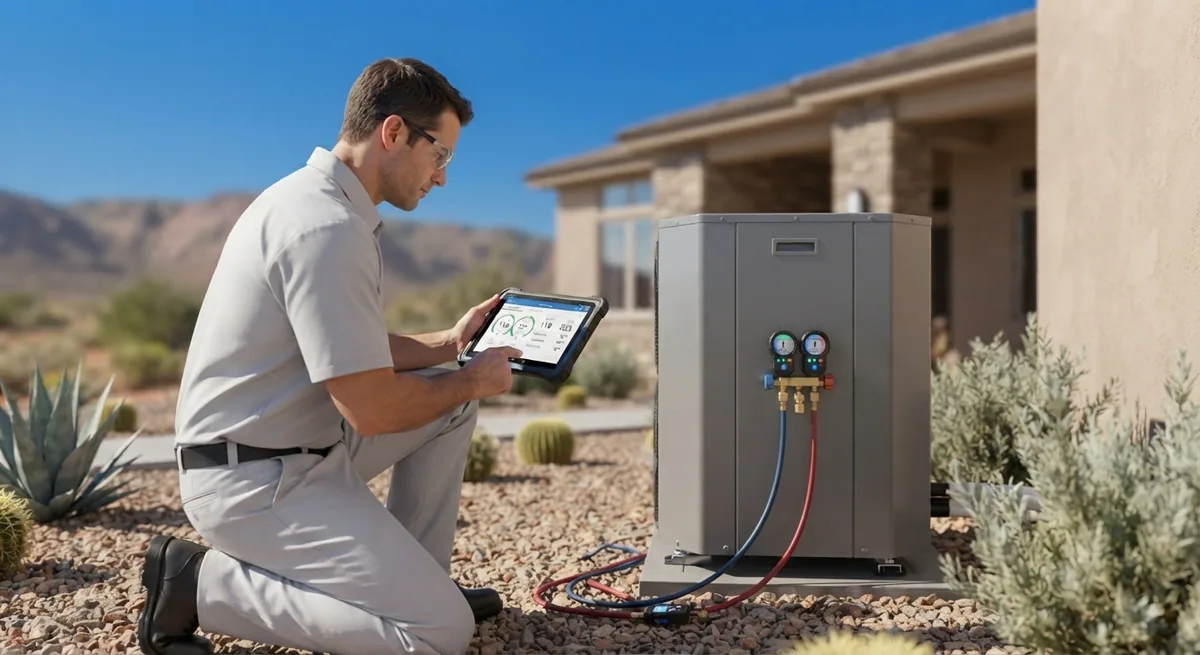
Quick Key Takeaways – Heat Pump Maintenance
Comprehensive Heat Pump Maintenance in Saint George, Utah
Unlike traditional split HVAC configurations where the air conditioner operates solely during the summer and the furnace operates only in the winter, a heat pump works continuously across all twelve months of the year in Saint George, Utah. In Washington County's extreme Mojave Desert climate, heat pumps endure operational run-times that exceed 3,500 hours annually—pumping heat out of your home during 110-degree summer heat waves and extracting heat from outdoor air to warm your living spaces during sub-freezing desert winter nights. Because heat pumps operate in two completely opposite thermodynamic directions, regular preventative maintenance is the single most critical factor determining equipment longevity, energy efficiency, and operational safety.
As part of our comprehensive residential and commercial HVAC services, our field dispatch network coordinates structured bi-annual heat pump maintenance programs across Saint George, Washington, Santa Clara, Ivins, and Hurricane. Every tune-up is conducted by background-vetted, professional HVAC technicians who utilize empirical digital testing instruments to inspect, clean, calibrate, and verify both the cooling and heating refrigeration circuits, electrical reversing valves, defrost controls, and auxiliary electric heat strips.
By investing in bi-annual preventative maintenance, you eliminate emergency breakdown anxiety, protect your valuable 10-year manufacturer warranty coverage, and maintain optimal seasonal efficiency, keeping monthly utility bills from Dixie Power or Saint George Energy Services as low as possible. To explore diagnostic troubleshooting, visit our heat pump repair service page, or review transparent pricing data in our HVAC maintenance cost guide.
Why Heat Pumps Require Bi-Annual Maintenance in Southern Utah
Operating a heat pump in Saint George exposes mechanical, electrical, and electronic components to severe environmental challenges that standard cooling-only units never face:
1. The Operational Wear of Year-Round Service
A standard air conditioner rests for six months during the winter. A heat pump never gets a vacation. In October, as outdoor temperatures transition from 90 degrees to 45 degrees, the heat pump shifts its thermodynamic cycle. The compressor, outdoor fan motor, indoor blower, and electronic expansion valves continue to log daily operating hours. This continuous duty cycle accelerates bearing lubrication breakdown, electrical capacitor dielectric wear, and contactor point pitting, making bi-annual inspections essential.
2. Abrasive Dixie Red Sand Dust and Coil Fouling
Saint George's fine red sandstone dust presents an ongoing operational challenge. During summer wind events, red sand accumulates deep within the outdoor condenser coil fins. If left unwashed, this insulating dust layer restricts airflow, elevates head pressures, and strains compressor motor windings.
In the winter, that same outdoor coil functions as the evaporator coil, absorbing heat from cold outdoor air. Dirty, silt-fouled coil fins freeze over much more rapidly, creating heavy frost accumulation that forces the unit into frequent, energy-wasting defrost cycles. Professional maintenance includes non-acidic foaming chemical coil washes that lift abrasive red sand without damaging delicate aluminum fins.
3. Reversing Valve Solenoid and Mechanical Slide Calibration
The four-way reversing valve directs the flow of hot refrigerant gas to either the indoor or outdoor coil, depending on the thermostat mode. During summer high-ambient operation, compressor oil can overheat and create microscopic carbon varnish inside the valve body. If not checked and calibrated, the internal slide can stick midway, causing high-pressure refrigerant to bypass directly into the compressor suction port, crippling both heating and cooling performance.
4. Defrost Control Logic and Thermistor Degradation
During winter operation, when outdoor temperatures drop below 40 degrees Fahrenheit with winter desert humidity, frost forms across the outdoor coil. The system relies on outdoor ambient air thermistors, coil temperature sensors, and electronic timer boards to initiate and terminate the defrost cycle. If an outdoor thermistor drifts out of calibration, the unit will fail to defrost, encasing the outdoor unit in solid ice, bending coil fins, and causing fan motor burnout.
The 24-Point Comprehensive Heat Pump Maintenance Checklist
When a professional technician executes a heat pump tune-up through our network, they perform an exhaustive 24-point empirical inspection covering heating, cooling, defrost, and auxiliary backup systems:
REVERSING VALVE AUDIT → DEFROST CYCLE SIMULATION → REFRIGERANT SUBCOOLING → AUXILIARY HEAT STRIPS → COIL WASH → TESP
Refrigeration Circuit and Reversing Valve (Points 1–6)
- Reversing Valve Operation Test: Energizing and de-energizing the 24V solenoid coil to verify clean, instantaneous valve shifting.
- Reversing Valve Temperature Differential: Measuring temperature drop across all four copper ports with infrared probes to rule out internal slide leakage.
- Cooling Subcooling Measurement: Connecting digital manifold gauges and pipe thermistors in cooling mode to verify exact liquid subcooling.
- Heating Superheat Verification: Measuring vapor superheat and suction pressure in heating mode to confirm proper heat absorption.
- Electronic Expansion Valve (EEV) Stepper Test: Inspecting EEV micro-stepper motor communication and superheat regulation.
- Refrigerant Leak Detection: Inspecting service port cores, coil hairpins, and flare connections with an electronic halogen leak detector.
Defrost System and Outdoor Unit (Points 7–12)
- Forced Defrost Simulation: Jumpering test pins on the outdoor defrost control board to force a live defrost cycle and verify sequence timing.
- Defrost Sensor and Thermistor Calibration: Testing outdoor ambient air and coil temperature thermistors against resistance-temperature curves.
- Outdoor Fan Motor Amp Draw: Measuring fan motor running amperage and checking motor bearings for axial play.
- Dual Run Capacitor Testing: Measuring microfarads on compressor and fan run capacitors with a digital multimeter.
- Electrical Contactor Point Audit: Inspecting heavy-duty magnetic contactor points for pitting, carbon scoring, and insect debris.
- Chemical Outdoor Coil Wash: Applying high-foaming, non-acidic coil cleaner to flush embedded red sand dust and debris.
Indoor Air Handler and Auxiliary Heat Strips (Points 13–18)
- Auxiliary Heat Strip Amp Draw: Measuring running current on each individual 5 kW electric resistance element with a clamp meter.
- Thermal Sequencer Staging Test: Verifying that heat strip sequencers stage heating banks smoothly without causing voltage drops.
- High-Temperature Limit Switch Test: Testing high-limit safety cutoffs and fusible links to ensure complete fire safety.
- Indoor Blower Motor Testing: Measuring ECM variable-speed blower motor amperage and checking electronic module connections.
- Centrifugal Blower Wheel Inspection: Checking blower wheel blades for dust buildup that restricts cubic feet per minute (CFM) airflow.
- Condensate Drain Evacuation: Clearing the indoor condensate P-trap with pressurized nitrogen and placing algae treatment tablets in the drain pan.
Airflow, Ductwork and Controls (Points 19–24)
- Total External Static Pressure (TESP): Measuring duct static pressure across the air handler with a differential digital manometer.
- Indoor Temperature Split (Delta T): Measuring return air versus supply air temperature rise (in heating) and temperature drop (in cooling).
- Air Filter Replacement and Housing Audit: Inspecting return air filtration and advising on high-MERV upgrades to capture desert dust.
- Thermostat Calibration and Staging: Verifying digital thermostat communication, heat pump reversing valve logic (O/B terminal), and emergency heat switching.
- High-Voltage Disconnect and Lug Torque: Tightening electrical lugs and checking disconnect switch condition.
- Inverter Drive Board Inspection: Inspecting outdoor inverter electronic circuit boards for thermal stress, dust accumulation, and terminal tightness.
Bi-Annual Maintenance Schedule: Spring Cooling and Fall Heating
Because a heat pump serves two distinct functions, preventative maintenance is divided into two seasonal tune-ups:
| Seasonal Visit | Optimal Timing in Saint George | Primary Focus Areas | Key System Deliverable |
|---|---|---|---|
| Spring Cooling Tune-Up | March to Early May (Pre-Summer) | Chemical condenser coil wash, dual capacitor testing, subcooling calibration, condensate line clearing | Guarantees peak heat rejection during 110°F+ Mojave Desert summer heat waves |
| Fall Heating Tune-Up | October to Early November (Pre-Winter) | Reversing valve cycling, defrost board simulation, auxiliary electric heat strip testing, static pressure balance | Ensures dependable warmth and prevents frozen outdoor coils on 25°F freezing desert nights |
The Value of Preventative Heat Pump Maintenance
Investing in structured bi-annual heat pump maintenance delivers proven financial and operational returns for Washington County homeowners:
- Preserving 10-Year Manufacturer Warranties: Leading HVAC equipment manufacturers explicitly mandate annual or bi-annual professional maintenance. Maintaining documented service records protects your 10-year compressor and parts warranty coverage.
- Lower Monthly Utility Bills: A heat pump with clean coils, properly balanced refrigerant, and calibrated expansion valves operates with up to 20 percent greater efficiency, saving hundreds of dollars annually on Dixie Power or Saint George Energy Services electric bills.
- Eliminating Emergency Breakdown Stress: Approximately 85 percent of all catastrophic compressor burnouts and motor failures are preceded by detectable electrical microfarad loss or coil fouling that can be identified and corrected during a routine tune-up.
- Extending Service Lifespan: With bi-annual professional care, a modern inverter heat pump in Saint George can easily achieve 12 to 15+ years of reliable operation despite the harsh desert climate.
Serving All Washington County Communities
Our heat pump maintenance teams provide dedicated scheduling across all local municipalities:
- Saint George, UT (84770, 84790): Bloomington, Little Valley, SunRiver, The Ledges, and Stone Cliff. Review our Saint George location page.
- Washington, UT (84780): Washington Fields, Coral Canyon, and Green Springs. Visit our Washington UT dispatch page.
- Santa Clara, UT (84765): Historic Santa Clara and elevated hillside subdivisions. Explore our Santa Clara UT page.
- Ivins, UT (84738): Snow Canyon corridor and Kayenta. Read our Ivins UT overview.
- Hurricane, UT (84737): Central Hurricane and Sky Mountain. Visit our Hurricane UT page.
Frequently Asked Questions About Heat Pump Maintenance
Why does a heat pump need maintenance twice a year when an AC only needs it once?
A standard air conditioner only operates for 5 to 6 months during the summer. A heat pump operates year-round, cooling your home in the summer and reversing its thermodynamic cycle to provide heat in the winter. Because a heat pump accumulates twice the operational hours and switches mechanical operating modes twice a year, bi-annual servicing (spring and fall) is required to ensure both cooling and heating systems are operating at peak efficiency.
What happens if I never maintain my heat pump?
Neglecting heat pump maintenance in Saint George leads to dirty outdoor coils, which dramatically increase compressor operating temperatures and electrical power consumption. In winter, an unmaintained heat pump frequently fails to defrost, encasing the outdoor unit in solid ice and forcing the system to run on expensive electric resistance heat strips, which can cause monthly electric bills to skyrocket while leading to premature compressor burnout.
Can a tune-up fix an issue where my heat pump blows lukewarm air?
Yes. During a tune-up, the technician tests refrigerant charge, reversing valve operation, and auxiliary heat strip staging. Frequently, lukewarm air is caused by an undercharged system, a slipping reversing valve slide, or burned-out heat strip sequencers—all of which are diagnosed and addressed during a comprehensive service visit.
Schedule Your Precision Heat Pump Tune-Up Today
Protect your investment and guarantee year-round comfort in Southern Utah. Connect directly with our Saint George field dispatch desk to schedule a comprehensive 24-point heat pump tune-up with an experienced, background-vetted technician.
Call us today at (435) 348-8603, or submit your appointment request online through our contact page.
Dispatch Field Hotline
Connect directly with our local response coordinator to route a technician to your property.
(435) 348-8603Related Trade Services
Pricing Transparency
Review current regional parts and labor benchmarks across our comprehensive local pricing directory.
Explore HVAC Cost Guides →Our 4-Step HVAC Service Methodology
Engineered to guarantee rapid local response, empirical diagnostic accuracy, upfront pricing clarity, and code compliance.
Discovery and Dispatch
Direct telephone intake with our Saint George dispatch desk to record symptoms, assess thermal urgency, and route the nearest field unit directly to your property.
Empirical Diagnostic
Comprehensive physical, thermal, and electrical diagnostic testing of your cooling or heating system to pinpoint the root mechanical failure without guesswork.
Clear Project Estimate
We clearly explain our diagnostic findings and provide a transparent, itemized written estimate detailing scope and materials for your approval before starting work.
Precision Execution
Flawless repair or installation utilizing OEM parts, adherence to Utah mechanical codes, full thermodynamic testing, and thorough clean-up upon completion.
Speak Directly With Our Field Dispatch Desk
Connect immediately with our local Saint George response desk for prompt technician dispatch, empirical diagnostics, and clear project estimates.